Showing posts with label choose. Show all posts

Thursday, February 14, 2013

TO KAVA OR NOT TO KAVA


Kava trees as they grow.


The Tongan farmer looked at the visiting Paalangi.  “This is kava.  Kava is a royal crop, Brother.  I have more than 200 acres of it growing on my plantation.  This is how I shall provide an education for my children and for my grandchildren, from the sale of kava. We make juice from the roots.  Will you honor me by trying some?”


Squeezing the juice from kava roots.


The Paalangi looked long at the Tongan.  “Brother Vai, I have never seen kava before.  But I have just had a prompting from the Holy Ghost that kava is not good for the body. I shall not drink any today.  Still, I thank you for your invitation, and your good will.”

Dried kava roots

 The Paalangi left, and Brother Vai sat down to think.  Then he stood, and thought some more.  And then he walked, and thought some more.  Much, much later that night, he went to bed.

 The next morning, Brother Vai called his plantation workers together.  "We will uproot every kava tree on this plantation,” he said, stunning his workers.  “I will not grow kava any more.”

The workers would not confront their employer, but later they complained among themselves.  "He can't be serious!" said one.  "The other plantation owners will say he's gone mad," said another.  "What is he thinking?  He will have no money, and we will have no jobs!" protested a third.  Still, they obeyed their employer.  He was firm; every kava tree had to go.  


Many weeks later, the last of the kava trees was removed from the ground.  The workers watched in amazement as every tree was chopped up for firewood, and the valuable root systems burned.  Now that the job was finished, the plantation owner explained himself to his staff.

“I trust this Paalangi who came to our plantation.  I know in my heart he is a man of God. I know that he is inspired of God, and I trust his judgment based upon that inspiration.  He was the one who told me that kava is not good for the body.  I will not grow anything that is harmful to anyone’s body.  I will apply in my life the principles that I know are true; and one of those principles is to never harm another person.”

The workers now understood why Brother Vai had chosen to uproot his crops.  But how would he pay them?  How would they manage a plantation with no crops?
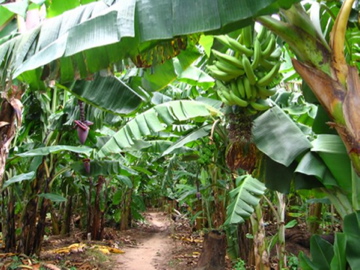
A banana grove.
Brother Vai started over.  He had banana trees, and bananas would always sell.  They would plant more banana trees.  Little by little, more crops were added: mangoes, melons, pineapples, root crops – and sooner than any of the workers had expected, the plantation was filled with beneficial vegetables and fruits.  And Brother Vai never let any workers go – they managed together.  The plantation thrived as never before; the weather seemed to support every planting, every harvest, and the workers came to understand the value of applying their faith in both word and deed.


This is what kava drink looks like.  It used to be used only
in ceremonies,but now is popularly used as a pastime.

I was told this story by the grandson of Brother Vai, whose entire family uses this story to teach each other the value of trusting in our leaders.  I don’t know who the Paalangi in the story was; it doesn’t matter.   What matters is that Brother Vai perceived the inspiration of a leader, and trusted enough in that inspiration to take the drastic step of destroying his own crops and then replacing them, without knowing for himself the reason.  (It is now common knowledge that kava is a mild hallucinogenic, is addictive, and can cause severe liver damage.)  Brother Vai , his children and grandchildren are strong, contributing members of the Church here in Tonga, and provide leadership in many wards and branches.  It is our pleasure to know and work with a few members of this family.  

Sunday, December 9, 2012

SEASON OF NEW GREEN


The green is still that new, "spring" green, even under the
trunk of a fallen tree. 
It is spring here in Tonga.  The grass is that bright shade of “new green”, and the crops are maturing at an incredible rate.  We have green mangoes – so called because they never really turn pink – and golden pineapples once again.  And I’m already salivating because the avocadoes are coming on the trees.


Outcroppings like these can be over very shallow or very deep water,
and the beach is very different at high or low tide.
We enjoyed exploring to a new place the other day, and watched a Tongan family play in the water at a beach that was only about 40 feet across, framed by coral outcroppings.  The parents and five children (ranging in age from about 16 to 3)  jumped into the water, raced the waves up and down the beach, swam through the surf, and tried (and succeeded) to catch a few sea creatures.  One boy caught a  creature of some kind – it had a shell, but I couldn’t tell exactly what it was.  He was quite excited to put it on the wet sand, watch the creature flop toward the water, then grab it again and move it back up on the shore.  He finally wrapped the creature in some aluminum foil, and took it home with him when the family left.  The crustacean will probably become part of the family’s dinner tonight.


The most fascinating moment when the youngest daughter, about 8 or 9, finally freed a crab from an abandoned net the family had dragged out of the water.  She took it over to her 16-year old brother, who talked to her about it for a few minutes. Then she handed him the crab, which surprised me, because she had not let any of her other brothers take the crab.  But she willingly handed the crab over to her oldest brother, and he in turn lobbed the crab back into the water.  Then the family began gathering together, and decided it was time to go home.  Within minutes the beach was quiet, as the last of the family waved goodbye to us.  The rest had already disappeared into the mangroves.

I was fascinated with the conversation and the actions of these two siblings, because they demonstrated to me a change in traditional family dynamics here in Tonga.  Most of the time authority rules here; fathers are feared more than loved, older siblings get their way at the cost of the tender feelings of younger siblings.  But not this time.  This older brother chose to teach his sister about this crab.  Perhaps he explained that it was not edible, or that it was too small.  In any case, her accomplishments and tender feelings were honored, and she in turn honored his greater knowledge, and allowed him to rescue the crab and return it to its saltwater home.  And both she and her brother were happy.  It was like watching a bit of “new green” in family relations here. 

We sat under a mangrove tree like this one.  
What a lesson.  It was an honor to watch this family enjoy each other’s company today, parents and siblings taking turns helping the little three-year old get used to the strong surf, younger brothers and sisters cartwheeling and flopping in the sand, and the older ones jumping into the water from the outcroppings.  Jim and I were blessed to be witnesses as this family shared a simple yet profound expression of love and joy in each other’s company.  As the season of spring continues, it is wondrous to watch the growth in the people of this tiny island.  

Wednesday, July 18, 2012

SOMETIMES YOU CHOOSE

Sometimes you choose, sometimes you’re chosen.
Jim and I chose to come to Tonga.   We continue to choose to be here.  We choose to work in education.  We choose to strive with these teachers, to help them make progress in becoming more effective teachers.  We choose to work with some very humble people, people who don’t need material items in order to choose to be happy themselves.  We choose to struggle to understand these people whose social habits are so different, who mature at different rates, who come to expect very different things of themselves than do most middle-class Americans.  And we continue to choose to learn from these people, to listen to them, to try to understand their viewpoints, so that we can be effective in our work with them.


But there is another missionary couple working here in Tonga who did not volunteer for this country.  They simply put in their application with the comment “send us where we are needed.”  Elder and Sister Bean are a humble, loving, considerate pair of people who would blossom anywhere they were planted, but there is a design apparent in their assignment here.

Some years back, Elder Bean’s father Eugene, who suffered from Alzheimer’s disease, got to the point where he needed a companion caregiver in his home.  The family hired a ‘Ofa, a young mother who happened to be Tongan, to come live with Eugene. She brought her young children with her, and was paid to attend to Eugene’s needs.  The experience of having young children in his home made Eugene’s last years very sweet; there were days when he didn’t know the woman and her children, but he didn’t care, for he had people around him to offer his love to, and to receive their love in return. The bond between Eugene and this young family grew very strong.


In time, Eugene passed away, and in his memory, ‘Ofa gave the family a gift; a very warm mink blanket.  Elder and Sister Bean took the generous gift, and placed it across the guest bed in the basement bedroom, where its warmth would be appreciated.  The blanket became known as the ‘Ofa blanket –  along with being her name, ‘ofa is the Tongan word for love.. The blanket became a favorite both of the Bean’s small grandchildren and their adult children, and was prized by all in the family.

The Beans filled out their mission application, and were called to serve here in Tonga.  Smiling at the memory of their association with the young Tongan mother, they looked forward to serving others like her.  But when they got to their little apartment here at Liahona, they had one more surprise.  The ‘ofa blanket was spread across their bed.  

No, it wasn’t the exact same blanket, but it was the twin of the one that had represented the love of a Tongan family for Eugene.  Now Elder and Sister Bean have a sweet reminder of the hearts of the Tongans in their home here, and that reminder has strengthened their commitment to serve.  

Another senior missionary, in her parting message to us last Sunday night, counseled us that “a lot of Palangi people try to change Tonga.  You won’t change Tonga, but Tonga will change you.” The longer I am here, the truer that statement becomes.  We thought we had chosen Tonga, but perhaps, just perhaps, like the Beans, Tonga chose us.