Showing posts with label Tonga. Show all posts

Saturday, June 1, 2013

A UNIQUE HOLIDAY

A holiday is coming up here in Tonga.  June 4th is Emancipation Day.  This marks two important milestones in this country’s history, and most Tongans regard it with the same kind of attitude that Americans have for Independence Day.

Okay, to give you a feeling for the reason it’s called “Emancipation Day” I need to give you something of a history lesson.  This little tiny country is the ONLY country in the South Pacific never to have been colonized by any European power, although there was a treaty of protection between Tonga and Great Britain that was valid from 1900 through 1970.  Today, Tonga operates independently, but in partnership with other nations.  For example, there are Tongan soldiers serving in U.S. and British units in Afghanistan.  There are agreements in place with Australia and New Zealand for Tongans to pursue higher education there.  And so on…

Tonga's first King, who took the Christian name
of George, after King George III of England
The first modern king of Tonga, King George Tupou I (the current king is George Tupou VI) came to power after civil wars had split the islands in the 1780s.  He was crowned king of one island group, then fought wars to unite all the island groups, and reigned as  king of all Tonga from 1845 until his death in 1893 (reportedly at age 100!).  He did some remarkable things, and is still revered in this country.
King George Tupou I also had this modest
palace built. It is still used today.

Before he was king of a United Tonga, this warrior king abolished the system of serfdom that had defined Tonga for hundreds, possibly thousands, of years.  He emancipated the lowest echelons of Tongans from obliged servitude to those born into positions of nobility or royalty. It took until 1862 for this law to be in force in all 176 islands, but every Tongan “commoner” was emancipated.  Then he took the unprecedented step of writing into law the allowance for every Tongan male to have land to work.  Every Tongan male, at age 16, is entitled to rent-for-life a plot of bush land (away from the village, similar to the 18th century practice in the U.S.) for a nominal fee, in order to provide food for his family.  Each male Tongan was also given the right to a smaller plot of land for a village home.  Today, the land is limited, and plots of land are not as big as they used to be, but many families still work the land rented to them by the King:


A more mature King
 George Tupou I


George took this step because he had been baptized a Christian in 1831. And this Christian perspective caused him to take one more step that no other reigning king in recent history has done: he consecrated his land and people to God.  His words, translated into English, are “God, our Father, I give you my land and my people, and all generations of people who follow after me.”  He went on to beg the protection of God for his people, the waters, and the creatures of Tonga and its waters.  Is it any wonder that Tonga has received special protection?  Is it any wonder that this country is one of the few left on earth where all businesses are closed on Sunday, in honor of the Sabbath?  Is it any wonder that Tonga’s people love the Lord?  Their king consecrated them to God’s keeping, to God’s service. 


Tonga's Queen and Queen Mother
The reigning king of Tonga


The kings (and one queen) since George Tupou the first have used a royal seal, upon which is printed, “God and Tonga are my inheritance.”  Not “my God-given right”, not “my kingdom”, but “my inheritance.”  They are keenly aware that their position is a stewardship.  The current king and queen are working to bring a higher standard of living to Tonga through improved health and educational resources.  This tiny country, consecrated to God for more than a century and a half, has more than a few things to teach the rest of us. Call it Emancipation Day, call it Consecration Day, call it Tonga’s national day – I call it a lesson for the rest of us. 

Monday, April 29, 2013

LAND OF LIGHT


Living in the tropics where days do not shorten and lengthen as much as they do in more temperate latitudes, I have come to rely on the rhythms of the sun to measure my day.  If I wake up and the sun is above the trees, I know I’ve overslept.  But if the sky is just beginning to brighten, then I know I have time to get ready for the day without rushing. 
Sunrise in my back yard.  Yeah, it's a hardship assignment here.

The other night we ate dinner with friends at a restaurant, watching storm clouds approach the northern shore of the island.  Their dark, heavy appearance made us willing to hurry through our dinner and get back into the car, to get home so we could be safe.  We knew that the clouds would bring only rain, not high winds, but the foreboding nature of the clouds was enough to make us concerned.  We had no care to stay and experience the coming rains, as announced by the clouds.  So, we hurried back to enjoy the storm from the safety of our little home, turning on electrical lights to fend off the darkness of the clouds and rain.  As I sat and pondered in our home, some very loosely connected thoughts came to me:

1.  I have heard darkness defined as “the absence of light”.  That definition is used in black and white photography, but I also see it as a metaphor for my life.  The light of knowledge, the light of truth, the light of understanding – my purpose is to seek for light, and then use it to guide my decisions.  I know the standard of light - the quality of light I want to develop in myself.  I must guard myself against absenting myself from the light, and make my choices based upon the quality of light each alternative will provide.  

The other day I was working with some of the leaders of the boys' dorm, and we talked about the word "praiseworthy."  We talked about making decisions based on the praiseworthiness of each choice - which of two good things would you rather be congratulated on?  Which of two (or more) good things would you want your parents, or your leaders, or the Savior, to see you doing?  That is the praiseworthy test.  

One teacher doing a presentation in one of the
classes I teach after school.
2.  The light of education has been easy for me to seek. I have a deep love for the light of learning.  I appreciate the new understandings I gain when I search, and for the new understandings I can impart to others as I teach.  As I work with teachers here in Tonga, I love to watch the light in their faces as they master a new skill, or comprehend a new concept.  But there is so much more for them, and me, to learn.  May we have enough light to understand how to accomplish our worthy goals.

My "tall sister" and her daughter - I am the short sister!
3.  Light is within us all.  I need to remember that.  As I work together with others, I need to remember to bask in the light of others, and absorb the light of understanding - exemplified by the woman in this photo, who asks me almost
as many questions as I ask of her;  the light of patience, exemplified by a teacher who sat there with me for eight hours while we tried to get the computer to cooperate (eight hours - seriously????); the light of love, exemplified by Lehua (at lower left), one of the dorm girls who I have been blessed to know.  When I allow myself time to absorb light from others, I can do more than reflect the light of others – I can become a stronger source of light for others. 


Whether I seek physical sunlight, or the light of education, or the light of love and understanding, or even the light of Jesus Christ, the benefits are the same: increased happiness and capacity.  And isn’t that what we all want in life?


Wednesday, April 17, 2013

TINY STORIES

Just a crazy quilt today of pictures and thoughts.  No special connections, no "moral of the story" - just a hodgepodge.

This is a picture of a semi-traditional Tongan home.  It's probably about 12 feet wide by 6-7 feet deep.  Most of the more traditional homes have only two rooms - parents' sleeping room and a common room. All the cooking is done outdoors, on an open fire, and bathroom needs are met by hand-dug latrines and buckets of water.  The shutters, closed against the rain in this picture, can be propped open to allow for ventilation.


This house is more indicative of how most people live in Tonga:  a simple, concrete structure with four or five rooms (common room, parent bedrooms, boy's bedroom and girls' bedroom, perhaps a room for extended family).  The corrugated metal fencing around the yard is to keep the pigs out of the yard, so it's called a pig fence.  This house even has a catchwater system, to store rainwater for household use in the big cement cistern to the right.  The smaller green cistern to the left holds treated water, delivered to the house, for drinking and cooking.  


This is a picture of a missionary, standing beside a child who in my book is an expert fisherman - he caught this small leopard shark with his bare hands.  Not bad for a 9-year  old boy, eh?  "Hey, mom, I got dinner for all of us!"  Families are often seen wading through the waters at low tide to harvest shellfish and urchins to eat - and my goal is to get a picture of a pig in the water, rooting for urchins!!!


This is a typical scene on the road.  You can see whole truckloads of students being delivered to the school here each morning - people find a place to sit, on the corners of the truck bed walls, or standing and holding on to the frame behind the cab window, or just lying down in the bed of the truck.  Don't panic, though, most of the time they're holding on very well, and the trucks rarely go more than 30 mph!


This is John (in Tongan, Sione = say See-OH-nay), one of our security guards here at Liahona.  Our school colors are green and white, so someone found these shirts and bought them for the security guards.  I have to smile when I read the pocket tabs, though:  Homeland Security.  Without going into detail, let me assure you that security at Liahona is much more relaxed than any security system I've ever seen anywhere else.  But we don't need a lot, either.


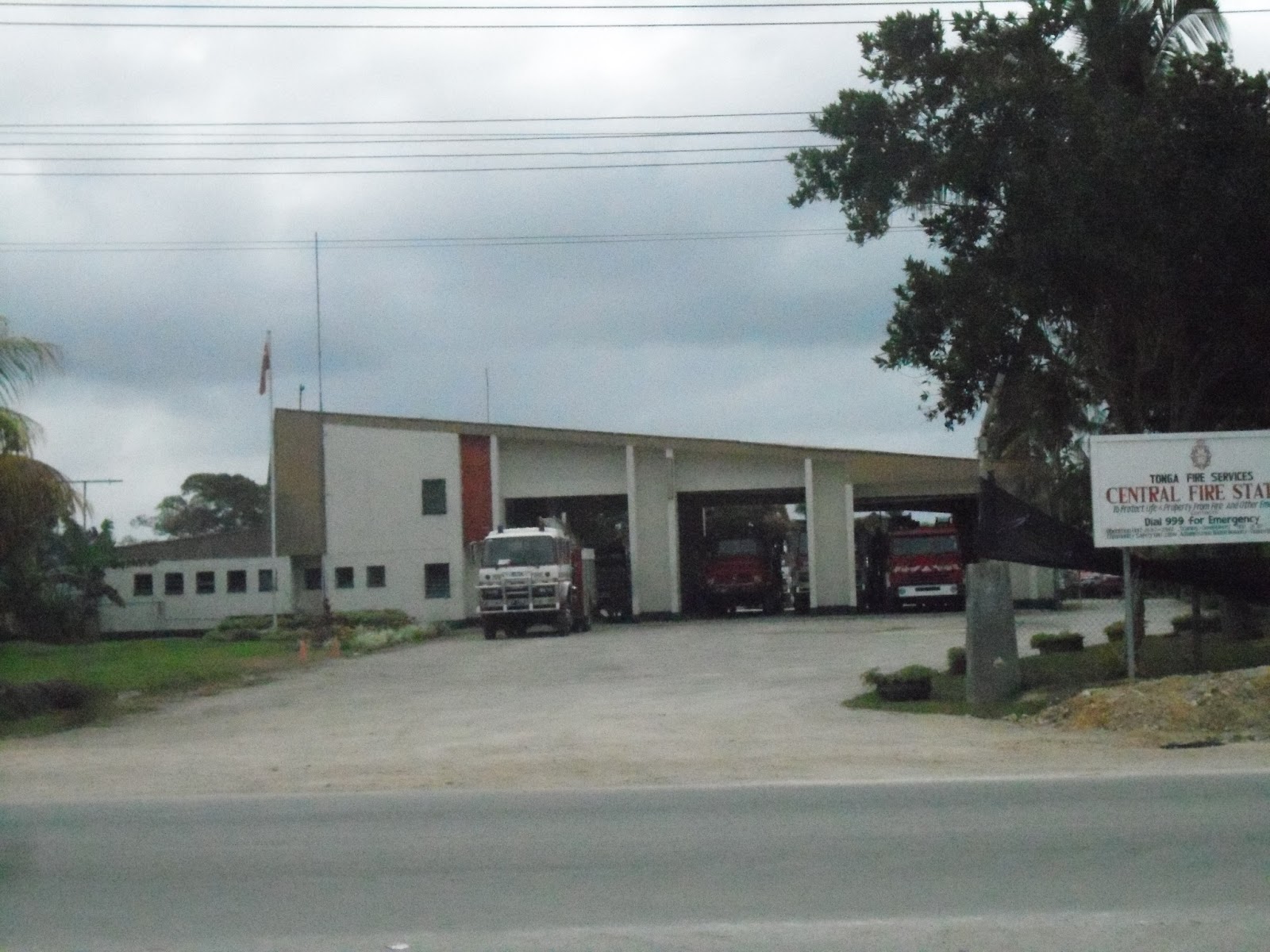
This is the fire station here.  And by "the fire station", I mean THE fire station.  There's only one in Tonga.  They stay busy!  They have a couple of small tank trucks and a pumper.  Does anyone know a multi-millionaire who would be willing to donate a couple million dollars to build and equip a second station on an island of 70,000 people?


The next picture is just so you know we aren't deadly serious all the time.  This was a mock trial at our recent principals' conference - English powdered wigs and all - charging principals with (shock and horror) making improvements to their educational programs!!!  Turns out they were all guilty, and each was sentenced to eating a 24-ounce chocolate bar at one sitting!


This last picture shows the dais built for the King of Tonga when he came to hand out diplomas at graduation.  This temporary structure was built out from the stage in the school gym/auditorium, and then covered in traditionally woven and painted mats.  The different weaves, patterns and styles of decorating reflect the different clans on this and some of the other islands in Tonga.  But the thing that amazed me most about the whole graduation ceremony was that students climbed up the steps at the right, received their diploma from the king, and then BACKED DOWN the steps again, because it is disrespectful to turn your back on the king!  


Life in Tonga is simple, unstressful, and slow.  And I am learning to appreciate that.

Thursday, February 14, 2013

TO KAVA OR NOT TO KAVA


Kava trees as they grow.


The Tongan farmer looked at the visiting Paalangi.  “This is kava.  Kava is a royal crop, Brother.  I have more than 200 acres of it growing on my plantation.  This is how I shall provide an education for my children and for my grandchildren, from the sale of kava. We make juice from the roots.  Will you honor me by trying some?”


Squeezing the juice from kava roots.


The Paalangi looked long at the Tongan.  “Brother Vai, I have never seen kava before.  But I have just had a prompting from the Holy Ghost that kava is not good for the body. I shall not drink any today.  Still, I thank you for your invitation, and your good will.”

Dried kava roots

 The Paalangi left, and Brother Vai sat down to think.  Then he stood, and thought some more.  And then he walked, and thought some more.  Much, much later that night, he went to bed.

 The next morning, Brother Vai called his plantation workers together.  "We will uproot every kava tree on this plantation,” he said, stunning his workers.  “I will not grow kava any more.”

The workers would not confront their employer, but later they complained among themselves.  "He can't be serious!" said one.  "The other plantation owners will say he's gone mad," said another.  "What is he thinking?  He will have no money, and we will have no jobs!" protested a third.  Still, they obeyed their employer.  He was firm; every kava tree had to go.  


Many weeks later, the last of the kava trees was removed from the ground.  The workers watched in amazement as every tree was chopped up for firewood, and the valuable root systems burned.  Now that the job was finished, the plantation owner explained himself to his staff.

“I trust this Paalangi who came to our plantation.  I know in my heart he is a man of God. I know that he is inspired of God, and I trust his judgment based upon that inspiration.  He was the one who told me that kava is not good for the body.  I will not grow anything that is harmful to anyone’s body.  I will apply in my life the principles that I know are true; and one of those principles is to never harm another person.”

The workers now understood why Brother Vai had chosen to uproot his crops.  But how would he pay them?  How would they manage a plantation with no crops?

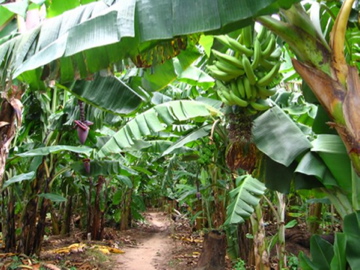
A banana grove.
Brother Vai started over.  He had banana trees, and bananas would always sell.  They would plant more banana trees.  Little by little, more crops were added: mangoes, melons, pineapples, root crops – and sooner than any of the workers had expected, the plantation was filled with beneficial vegetables and fruits.  And Brother Vai never let any workers go – they managed together.  The plantation thrived as never before; the weather seemed to support every planting, every harvest, and the workers came to understand the value of applying their faith in both word and deed.


This is what kava drink looks like.  It used to be used only
in ceremonies,but now is popularly used as a pastime.

I was told this story by the grandson of Brother Vai, whose entire family uses this story to teach each other the value of trusting in our leaders.  I don’t know who the Paalangi in the story was; it doesn’t matter.   What matters is that Brother Vai perceived the inspiration of a leader, and trusted enough in that inspiration to take the drastic step of destroying his own crops and then replacing them, without knowing for himself the reason.  (It is now common knowledge that kava is a mild hallucinogenic, is addictive, and can cause severe liver damage.)  Brother Vai , his children and grandchildren are strong, contributing members of the Church here in Tonga, and provide leadership in many wards and branches.  It is our pleasure to know and work with a few members of this family.  

Friday, January 4, 2013

MY TONGAN CRUSH


Chessy, Jinx, Inkblot, Celadon.  Those are the names that I tried to attach to my latest crush here in Tonga – a black male kitten.  I found him mewing outside the office one afternoon about a month ago, so young that his eyes were still turquoise blue.  I took him home, accepted my neighbors’ box as a den for him, and folded a little towel up for him to lie on inside the box (set on its side like a cave, protected by a little wooden stool on my back porch).  He recognized safety and food, and stayed there.

Cats are feral here, and scavenge the garbage, so we regularly leave scraps by the garbage for them (and dogs too).  But this kitten was so young he didn’t even know he was supposed to be afraid of me, and I knew he didn’t stand a chance of finding food on his own.  He weighed less than a kilo and fit in my apron pocket.  He slept there for over an hour his first evening with us - after I got a Christmas picture of him!

Jim was very tolerant of my choice to rescue this kitten.  We laughed at him when he would hiss and spit at the leaves of the plants blowing in the breeze.  We smiled as we watched him chase a plastic bag bunched up at the end of a piece of string.  We chuckled when he wrestled with a piece of netting (like onion bags).    And one of the reasons I could not settle on a name for him was because of his “helter skelter” move.  This tiny little kitten would arch his back, stick his tail straight in the air, fluff out all his fur to make himself as big as possible, and then he would walk, stiff-legged, AT AN ANGLE.  He looked like he was straight out of a cartoon! 

There were quiet, loving moments, too – especially during these last few days.  He came with me to the office a few times, and curled up between my arms while I worked on the computer, for two hours at a time.  He climbed up on me while I watched TV and tucked himself under my chin.  And he even got so he rode on my shoulder as I walked around.  Not much of a wild cat left in him.  His eyes changed color to a beautiful celadon green, and his black fur became shiny and long, with good nutrition. But he's still growing into his ears...


I had to accept the fact that I could not be the permanent owner of this cat.  Well, today, I was carrying him outside my unit and one of the school secretaries came up in her car, and exclaimed about the kitten.  I told her I was looking for someone to adopt him, that he was totally dependent on being fed, and she said, “I’ll take him.  I’ll take care of him, and make sure he’s happy.”  I trust this woman, and I handed her the kitten.  He curled up against her as she took him.  Before she left, I made her promise to let me visit!


I miss my little Tongan crush. I keep looking for him in the corner of my bedroom, or under the desk, or out on the back porch, but he’s gone.  Still, I have the comfort of knowing he’s loved, he’s safe, he’s cared for.  What more could a foster mother want?


Saturday, December 15, 2012

THE HELPERS


"When I was a boy and I would see scary things in the news, my mother would say to me, “Look for the helpers. You will always find people who are helping.” To this day, especially in times of “disaster,” I remember my mother’s words and I am always comforted by realizing that there are still so many helpers – so many caring people in this world.” - Mister Fred Rogers

In the US, this week was marked by the third school shooting of the year, but this one was different because the student victims were all under 10 years of age.  I have shared my heartbreak with friends both here and in other countries, but I am convinced it is my duty to BE one of the helpers that Fred Rogers spoke about.  I am limited in my choices of how to help; I am assigned to be here in Tonga, so I am not able to physically go to Connecticut. But there are still ways to offer my help, and I will find a way.

In considering this tragedy, I have reflected on my own life.  Being a helper has brought me wonderful blessings.  I have a different perspective on life because of the opportunities I have had to help others.  Whether helping in dramatic circumstances or quiet ones, helping has made me a better person.  And I am grateful to have had the opportunity to serve.  

During the early 1990s, I lived with my family in South Korea.  My husband was a high school principal, and I taught second grade to children whose parents were serving in the military.  One of those years, North Korea started threatening to invade South Korea.  After seeing soldiers practice drills and rehearse for war, watching Patriot missiles be positioned on the base, and feeling the tension in their parent’s attitudes, my little second graders became quite concerned.  One day I finally opened the issue for discussion in our class.

“What will happen to us if there’s a war, Mrs. Szoka?” 
“Yeah, if my mom and my dad both have to be gone, who’s going to take care of me?”
“What if the North Koreans try to take over the base?”

More and more questions like that rang out.  I pondered the questions, and knew I could not simply dismiss their feelings.  These children were genuinely worried.  It was up to me to show them that the military was prepared to keep them safe, too.  I smiled calmly at my students.

“Somewhere under this base is a very big underground bunker. It is large enough to hold every man, woman and child who live on this base, plus all the Americans who work here but live off the base.  If the North Koreans head for our base, we will hear sirens that will tell all the grownups to get their families together and go to the bunker.  If the sirens go off while we’re here at school, our school buses will take us to the bunker.  Then once we’re there, we will be divided up into groups to make sure everyone is safe.  I will stay with you the whole time, until your parents can come for you.  If your parents have to stay out of the bunker and fight, I will be with you.  I will keep you safe.  I will take care of you, and things will be okay.”

My students breathed a collective sigh of relief, and though there were still war games that brought soldiers too close to the school for my own comfort, they were able to go back to concentrating on their own job – that of learning.  I was grateful that God gave me the words to help those children.  Fortunately, the North Koreans did not invade, and life returned to a more peaceful calm for us on that base.

A few years later we were living in Naples, Italy, and I was involved in a car accident.  Before I could even think about what to do, two lovely Napolitanos were at my car door making sure I was unhurt.  I spoke only a few words of Italian, they spoke no English, but they invited me into their home, served me a glass of water, and gave me their telephone to reach my husband and notify the military police of the accident.  They even took the phone and gave specific directions to the police about where the accident had happened in Italian, so the police could get there more quickly.  In a very short time, my husband arrived with the police, and the car was taken away and we were provided a ride back home.  With new eyes, I watched highway behaviors from then on, and saw that no one who ever pulled over to the side of the road was ever left alone for more than a few minutes; Napolitanos helped someone in a broken-down car on the side of the highway today because they might need that same help tomorrow.    They took turns being helpers.

I have been a helper, but one of the strongest memories I have involves the comfort others brought me in a time of tension and fear.  During September and October of 2002, the so-called “D.C. Sniper” was at large, and no one knew when or where he would strike next. I worked at two schools in Northern Virginia that fall, and one of the schools was only a few minutes away from one of the sniper’s murder scenes.  Everyone was fearful; students did not complain when they were told there would be no outdoor recess until the sniper was caught – even the youngest kindergarteners recognized the schools’ efforts to keep them safe.  

One day as I was driving home after school, I tuned the radio to a station I had listened to with my parents as I grew up, and discovered a familiar voice.  One man who had been on the radio 25 years earlier was still with the station, even though the station’s format had changed.  As I listened to this man’s voice, I was filled with comfort; it was as though this voice from my past was sending me a message of hope.  The man’s words did not matter; it was his voice that I needed at that moment.  Simply hearing his voice in my car helped me, as I tried to deal with the tension of those weeks.

Another part of that story in which I watched the helpers took place at the school that was very close to one of the places where the sniper killed a victim.  Each morning at the school, buses would pull up to take turns discharging their students one bus at a time.  When students exited the bus, they found themselves in a gauntlet of teachers, a line both to students’ right and to their left, framing their path to the school’s front door.  These teachers voluntarily placed themselves in harm’s way on behalf of their students, and the students realized that.  As a result, students’ appreciation for these teachers grew by leaps and bounds in those weeks.  The harmony at the school that year was remarkable; students knew exactly who were their helpers, and depended upon teachers for comfort and safety, as well as academic learning.  It was a remarkable event to witness.

When Jim and I came to Tonga, we came to help.  We knew we had a lot to offer, and the longer I am here, the more urgently I see the need for what help I can give.  But if there has been one “loud and clear” message from my time here, it is that the act of helping is like a see-saw.  You help someone, and that action helps you.  You receive help from someone, and that action helps them, too.  

Tongans will bend over backwards to help.  Jim was given a flash drive at the open-air market just because he was wearing his missionary badge.  “No, you’re a missionary, take it,” said the young man, refusing to take any money for the item.  “I know I will be blessed for helping a missionary,” he said.  Just the other day, I took some of my Primary children Christmas caroling around the homes here at Liahona, and just for singing a few songs, some of the families wanted to invite us in to share some food, or they gave us an entire tray of sweet rolls, or they wanted to take a picture with us – their delight at being given a free gift was wonderful, and they wanted to give us something in return.  Most Americans are happy when they get help from someone; Tongans are happiest when they can GIVE help to someone.  They know that helping someone helps them, too.

When I am helping, I know it is not just me helping someone else.  I know I am gifted with the opportunity to help, the words, the actions, the perspective.  I know the source of my strength.  And I am grateful for the strength of others, when I am in need.  I hope I can continue to look for opportunities to help, and be humble enough to accept the help of others when they offer.  

Monday, November 5, 2012

THE FRIENDLY ISLANDS


Tui, who never seems to be without his smile.
Selflessness is almost a way of life here, but sometimes it still takes me by surprise.  Twice in the past week our friend  Tui (TOO-ee), who is a counselor here at the high school has stopped by with food for us – mangoes and kumala, a white sweet potato.  This is a man who has five children of his own to feed, but still finds a way to share.  “Tonga’s only mountains are in our hearts,” says a Tongan proverb – meaning that the challenge to create a summit of good character is of prime importance here.  Our friend has created his own mountain, and summited that mountain in quiet, humble service. 


Students would work in this kind of field.


We are not the only objects of his service, either – Tui is working on creating a program that will help students next year (school is over except for exams and national exams).  The program is kind of a work-study program, using the Church welfare farm to raise and sell crops to reduce their school costs.  If four acres of kumala (those white sweet potatoes, like the ones Tui brought us) can be planted and harvested three times during the school year, each boarding student’s total school cost will be cut in half.  Not bad for two or three hours’ work every Saturday morning.  Here’s hoping the area church leaders will approve Tui’s request.


This is a part of the Church farm here in Liahona.


Tui serves for the same reason as most Tongans – they are firmly convinced that their own spiritual welfare, indeed, their whole balance of spirit, emotion, intellect and social connection -  depends on finding ways to share.  Most of the rest of the human race are happiest when we receive something.  Most Tongans are happiest when they have the opportunity to give something.  Perhaps it is because they have so little, that they are so generous –  sort of “give now while I have something to give, because I may need someone else to be charitable toward me next week” thinking.   Whatever the reason, the generous nature of these people, as typified by Tui, is remarkable.  They don’t call Tonga “The Friendly Islands” for nothing.

Monday, October 15, 2012

ENDURE WITH LOVE IS THE CULTURE


The entrance to Liahona High School, dedicated by LeGrand Richards in 1953.
Pretty impressive by any standards.
Because of the wet climate, concrete sidewalks
 are everywhere.
Liahona High School in Tonga is an interesting mix of approaches and cultures, both in the way the organization is structured and in the way that people relate to each other.  One of the most British features is that it functions as a boarding school for about 80 of its students, who live in dormitories during the school year.  But imagine for a moment going to a boarding school, when the only thing you know that is bigger than your house is the ocean.  You come from a remote island, with very little exposure to even the still-developing standard of living here on the “big” island of Tongatapu.  
Major walkways are shelters from the hot sun and torrential rains,
regular features in the tropics.
So the shock of seeing concrete buildings, paved roads and sidewalks is dizzying, much less the shock of changing from family surroundings to a school of 1000 students.  Thankfully, the shared culture of the LDS Church helps students have an anchor here, and somehow they endure challenges that would have overwhelmed me at their age.


All students in Tonga wear school uniforms.
Liahona's colors are green and white, and
the two stripes represent the phrase
"by study and by faith,"the school motto.
Take Selu (SAY-loo) for example.  She comes from one of the other islands, a small island called Ha’apai (Hah-ah-PIE).  Her parents struggle to provide her with money for tuition, and since the kitchen provides two meals a day, breakfast and supper, Selu often goes without lunch, to save money.  But so do most of her friends, unless they buy some Ramen noodles or share a loaf of bread, two of the cheapest options for lunch at the store across the street from campus.

Selu spends the whole school year here, because her parents can only afford to bring her home on the ferry at the end of the school year.  So during the week-long breaks after each quarter and semester, she stays with relatives here on Tongatapu.  She misses her parents, especially her mother, but accepts the reality of spending ten months a year away from them. 

Selu has “dorm parents” who try to support her, but she is one of 40 girls in the dorm, so she has to create her own system of support.  Fortunately, the families here at Liahona spend a great deal of time with the dorm students.  Because of this support, and because of the way some of her teachers have extended themselves to her, Selu has found ways to succeed in school and be happy here.

Boys all over the Pacific islands wear a type of
wrap-around skirt. In Tongan it is called a tupeno.
Much cooler than trousers.
Sila (SEE-lah), one of the boys in the boys’ dorm, has had to work harder to find success.  He struggles with his English, since no one in his family speaks English at home, but he is expected to function in English during his classes.  He wants to do well, but is often frustrated with his lack of skills with the English language.

Sila’s dorm parents know that he is not the only boy who struggles.  So they have established a new system for the boys, assigning them in multi-age groups in rooms.  That way, 14-year old Sila has some older brothers in the dorm room with him.  These  older brothers have been trained to be guides and role models for Sila, and they take their responsibilities seriously.  Some of them serve as district leaders, a term borrowed from Mormon missions. District leaders are given the responsibility to make sure several room groups are functioning properly – that boys are where they ought to be, that problems are solved, that needs are addressed.  Sila’s  older roommates help him with his homework, teaching him the English words he needs to succeed.  They help him read his assignments, but they also spend ten minutes every morning and ten minutes every evening reading scriptures together.  They pray together, in their small groups, and all the boys in the dorm meet at 7 am every morning for a hymn, a prayer, and to share a spiritual thought. 

Saturday morning is not an opportunity to sleep in, either.  These dorm students are kept busy all week long.  Twice a month, before sunrise,  Sila and all the dorm students  go together to the LDS temple to serve by performing vicarious baptisms for dead relatives, to offer their deceased ancestors the choice of accepting the fullness of the gospel in the spirit world, while they await resurrection. The feelings and experiences they share about the chance to serve their ancestors are deep and frankly, too sacred to share here.  Just know that they come back from the temple happy.   


On the other Saturday mornings, Sila and the other  dorm boys go out to the Church farm and work “on the plantation”.  They usually spend about 4 hours there, then they are granted the afternoon off.  And at church on Sunday, Sila is surrounded by older brothers, who make sure he understands the lessons and feels the spirit of the messages he hears.  


I am amazed as I watch the dorm parents and their dorm students, that a couple, with children of their own, would be willing to take on an extra 40 children for ten months.  I smile as I watch the bonds of love that develop between these students and their dorm parents, their teachers, and the families who connect with them at church.  One of the “golden principles” of Tongan culture is love, and I see love in action every day here.  Life is challenging wherever you go, but because of their shared values, these teachers and students, these leaders and young men and women, are taking on the challenges together.