Showing posts with label Tongan king. Show all posts

Saturday, June 1, 2013

A UNIQUE HOLIDAY

A holiday is coming up here in Tonga.  June 4th is Emancipation Day.  This marks two important milestones in this country’s history, and most Tongans regard it with the same kind of attitude that Americans have for Independence Day.

Okay, to give you a feeling for the reason it’s called “Emancipation Day” I need to give you something of a history lesson.  This little tiny country is the ONLY country in the South Pacific never to have been colonized by any European power, although there was a treaty of protection between Tonga and Great Britain that was valid from 1900 through 1970.  Today, Tonga operates independently, but in partnership with other nations.  For example, there are Tongan soldiers serving in U.S. and British units in Afghanistan.  There are agreements in place with Australia and New Zealand for Tongans to pursue higher education there.  And so on…

Tonga's first King, who took the Christian name
of George, after King George III of England
The first modern king of Tonga, King George Tupou I (the current king is George Tupou VI) came to power after civil wars had split the islands in the 1780s.  He was crowned king of one island group, then fought wars to unite all the island groups, and reigned as  king of all Tonga from 1845 until his death in 1893 (reportedly at age 100!).  He did some remarkable things, and is still revered in this country.
King George Tupou I also had this modest
palace built. It is still used today.

Before he was king of a United Tonga, this warrior king abolished the system of serfdom that had defined Tonga for hundreds, possibly thousands, of years.  He emancipated the lowest echelons of Tongans from obliged servitude to those born into positions of nobility or royalty. It took until 1862 for this law to be in force in all 176 islands, but every Tongan “commoner” was emancipated.  Then he took the unprecedented step of writing into law the allowance for every Tongan male to have land to work.  Every Tongan male, at age 16, is entitled to rent-for-life a plot of bush land (away from the village, similar to the 18th century practice in the U.S.) for a nominal fee, in order to provide food for his family.  Each male Tongan was also given the right to a smaller plot of land for a village home.  Today, the land is limited, and plots of land are not as big as they used to be, but many families still work the land rented to them by the King:


A more mature King
 George Tupou I


George took this step because he had been baptized a Christian in 1831. And this Christian perspective caused him to take one more step that no other reigning king in recent history has done: he consecrated his land and people to God.  His words, translated into English, are “God, our Father, I give you my land and my people, and all generations of people who follow after me.”  He went on to beg the protection of God for his people, the waters, and the creatures of Tonga and its waters.  Is it any wonder that Tonga has received special protection?  Is it any wonder that this country is one of the few left on earth where all businesses are closed on Sunday, in honor of the Sabbath?  Is it any wonder that Tonga’s people love the Lord?  Their king consecrated them to God’s keeping, to God’s service. 


Tonga's Queen and Queen Mother
The reigning king of Tonga


The kings (and one queen) since George Tupou the first have used a royal seal, upon which is printed, “God and Tonga are my inheritance.”  Not “my God-given right”, not “my kingdom”, but “my inheritance.”  They are keenly aware that their position is a stewardship.  The current king and queen are working to bring a higher standard of living to Tonga through improved health and educational resources.  This tiny country, consecrated to God for more than a century and a half, has more than a few things to teach the rest of us. Call it Emancipation Day, call it Consecration Day, call it Tonga’s national day – I call it a lesson for the rest of us. 

Monday, April 2, 2012

THE DEATH OF A KING

We have been participants in history.
Yes, everyone can say that on a daily basis, but it’s not often we realize it while it's happening.  This week, a Tongan king was laid to rest, and we were privileged to be both witnesses and participants in the rituals surrounding his being laid to rest.
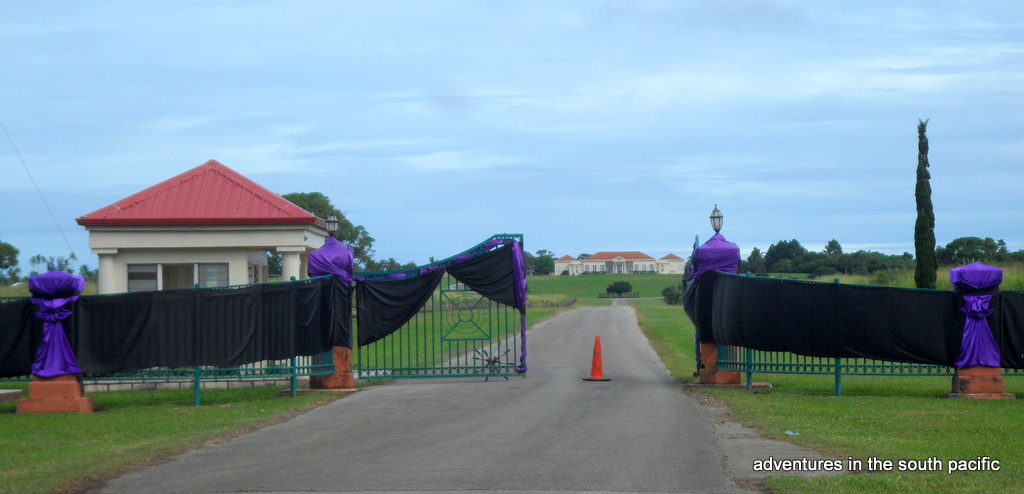
The King's villa, draped in black for mourning, and purple for nobility or royalty.  
King George Tupou V, age 63, had a kidney transplant a year ago, and never really recovered.  He still appeared at ceremonies and important political events, but he no longer toured his island in his converted London taxi, or entertained guests with Agatha Christie-style murder mystery parties.  He passed away in a hospital in Hong Kong, and last Monday, March 26th, his body was returned to Tonga in a Chinese jet.  Mourners from his family and the noble class of Tonga greeted his body in a ceremony at the airport, then his casket began the 10-mile-per-hour long ride to the royal palace. 
A little one walks down the road with a fan in her hand.  You can see the villagers who have laid tapa on the road in the background.  They are sitting on it simply to keep the wind from blowing it out of place.  
In his short five-year reign, this king had endeared himself to his subjects through his common touch.  In the videos I have seen of him (and there have been many over the last couple of weeks), I notice that he never seemed quite comfortable with the idea of being singular.  When he would stand in front of a crowd, his eyes would dart back and forth as though he was looking for someone else who deserved the attention more.  His expression varied from slight discomfort to evident embarrassment, which is a direct expression of the Tongan culture; no one here wants to be singled out in front of others as a commendable example.  All of the Tongans I have spoken with have reported that he had an air of accessibility, that for all his eccentricities (he enjoyed riding a motorcycle, and was known to wear a pith helmet), he communicated a concern for every citizen. 


Well, Jim has been asked if he's Tongan, but I'm just Sister Tomato, turning
red every time I sit out in the sun (forgot the sunscreen!).
All along the road from the airport to the palace, Tongans (and a few of us non-Tongans) waited to pay respect to their fallen king.  We didn’t know exactly what time the Chinese jet would land, but the entire student body of Liahona High School and Liahona Middle School (1300 students), plus faculty, staff and administrators, waited out on the road for his body to pass.  Every other school in Tonga had their students gathered on the road as well – children from age 6 to 19 were all in their school uniforms, while adults wore the traditional black clothing with a straw mat and dried-grass skirt.  Most of us were on the roadways by 11, and the police, in their white dress uniforms, were diverting traffic by 12.


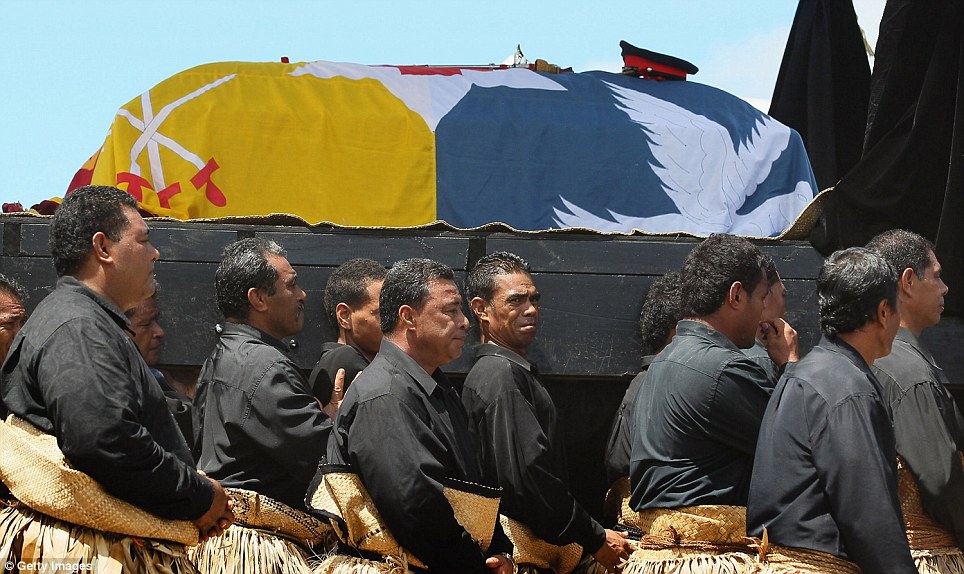
It was a quiet social time, until about 3:00, when we finally had a police car go by with headlights and roof lights flashing.  That was our signal to go sit down on the edge of the road and be silent.  After a few more minutes of waiting, we saw the big elevated-flatbed truck coming down the road, with a ceremonial canopy that probably was 30 feet in the air. The royal flag was draped over the coffin, and as it passed by, every head bowed low in respect.  As far as the eye could see, the road was lined with silent people, as the truck, then a procession of cars with dignitaries and Tongan nobles passed by.  A few of us Palangi (non-Tongans) lifted our heads long enough to get pictures, but I didn’t see a single Tongan head lift until every car had passed. 

Then the sociability returned – people smiled, laughed, and helped each other into cars and buses to return home.  We were still dressed as mourners, but we were determined to be happy, for that is what King George Tupou V would have wanted.

This is St. Andrew's Church, with the most beautiful bunting in the nation right now.

On Monday night, tiny vigil fires were built all around the palace fencing, and students from many schools tended the fires all night long, while church groups from all over Tonga participated in prayer services on the palace green. The LDS Church was well represented, with more than 200 people seated under a tent to sing hymns and offer testimony and prayer during their assigned hour. 
The funeral casket, bier and canopy begin their journey from the palace to the royal tombs.   


The funeral was held Tuesday.  150 pallbearers carried the king’s coffin on a huge bier – a frame that was at least 50 feet long and 20 feet across.  There were extras who walked right next to the pallbearers, so that when one was exhausted by the weight, someone was ready to take his place.  


They followed elite military units -  Army, then Navy, then the royal military band – in a hesitation-step march from the Palace to the royal burial ground and tombs – about a 30-minute procession.  As on Monday, special handpainted cloth made from pounded bark called “tapa” (TAH-pah) served as carpeting for the military and pallbearers to walk upon for much of the procession.  Each large tapa you see in some of the pictures I’m posting today represent about 2000 hours of work.


The Free Wesleyan Church of Tonga conducted the funeral, but there were representatives from all churches present, along with international dignitaries (the crown Prince of Japan and his wife both attended, along with the Prime Minister of New Zealand and too many others to list). 
Then Wednesday was a day to breathe.  School was in session, but I imagine not a lot was accomplished.  Too many students were thinking about what their offerings would be on Thursday.  I know my teachers were not in learning mode for their class after school - only half of them even attended.  


The bush is a plant called kava, part of a ceremonial drink,
and the big long root vegetables are called ufi (ooo-feee).
And yes, those are live pigs in the cages.
Thursday:  Ha’amo Day. This was the day that the poorest of the poor bring their best gifts to the royals, as evidence of their grief.  So about 700 pigs ready for slaughter (the big ones, not the little piglets that families often barbecue), miles upon miles of tapa, root vegetables and bananas by the bearing-basketful, and any kind of treat families can come up with – leis of candy, cookies, cakes – all donated by people whose average income is probably about $100 a month.  The new king seems set to change this tradition, but he may not be able to do it in time for this round of ha’amo (hah-AH-moh).  As comfort to the Queen Mother, every family with students at Liahona was asked to prepare a cake or sweetbread for her.  That’s about 650 cakes.  What? We’re going to run out of flour!  This is an island, remember?  Panic is setting in on my little Palangi brain…


These baskets are about three feet long each, and are carried
 in by two people. And you can see the cakes!


Ah, we'll manage, say my Tongan friends.  It won't be the first time we've done without.  She's the Queen Mother, and she has lost her son.  We'll show her our sympathy and devotion to her with our gifts, and then later we'll figure out how to cook for our own families.  These humble, faith-filled people are used to sacrifice.  Looks like it's my turn to be taught.