Showing posts with label lds. Show all posts

Sunday, March 31, 2013

Happy Easter


Of all the wondrous events of Easter, of all the eternal scope of the purpose of Easter, of all the magnificence of the Atonement of Jesus Christ for all the sins of every person who has ever lived or who will ever live on the face of this earth, there are two small moments, both huge in portent, which have caused me long reflection this Easter season.

The first comes in the Garden of Gethsemane.  Christ is suffering the unimaginable agony of atoning for every sin ever committed, and he pleads with the Father to "remove this cup from me: nevertheless not my will, but thine, be done." (See Luke 22:42.) 

As a result, our loving Father in Heaven sent down an angel. This angel is portrayed in a wonderfully tender pose in the painting by the 19th Century Danish painter Carl Bloch:


Can you imagine this angel's reaction when he was assigned by the Father to go strengthen and comfort the Savior?  Can you imagine what a treasure that assignment would be?  I am pretty sure that if I was watching from heaven, I would have been just a little bit jealous of the angel who got to go down to earth and put his arms around the Savior, telling him, "You can do this." What love was shown for the Savior by our Father in Heaven, to send an angel to strengthen him and support him as he went through the most anguish anyone has ever experienced. 


That circle of support, however, shrank steadily through the events of the midnight trial and scourging, and the harrowing walk to Calgary, where more physical torture awaited the Redeemer of mankind.  The second moment that has stayed on my mind is that of Jesus on the cross, when most of his mortal friends have left, and he realizes that his Father has left him to his own devices.  "My God, my God, why hast THOU forsaken me?" Both the prophet Brigham Young and the apostle James Talmadge have said that our Father in Heaven had to turn away, had to go hide in some far corner of heaven, so as to keep from interrupting this last portion of the Atonement.  He had to hide, to allow Jesus to finish the job on his own, but the Father had also reached his limit - he was ready to end his son's suffering, but knew he needed to let the Atonement come to completion.

The Empty Tomb.  Artist unknown.
The glory of the resurrection is the reason for Easter.  The promise of living forever is given to all, and the promise of the quality of that immortality is offered to those who follow Jesus Christ's example and our Heavenly Father's commandments.  May we come to appreciate the love of our elder brother Jesus Christ and our Father in Heaven, and choose to align our lives with the words of Jesus Christ and the will of the Father.  Happy Easter.


Wednesday, October 24, 2012

UNIQUE EXPRESSIONS OF LOVE


Every culture honors its dead in unique ways.  Tonga is no exception.  


Tonga is an island formed by coral pushed up from the seabed.  So when you dig, you don't have far to dig before you hit solid coral.  As a result, most graves are created by creating frames for raised mounds.

Whether by forming a concrete frame or by laying blocks, graves are clearly defined by borders.  And the grave markers you see are not what most people are used to:  Here, where natural stone is incredibly expensive, families use fabric and wood.


The marker of choice is a quilt.  It's far too warm, most of the year, to consider using a quilt on a bed, but somehow quilts have become quite popular as beautiful grave markers.  This quilt takes the names of a husband and wife and frames them with depictions of the heilala flower, a tiny flower unique to Tonga.  We have also seen graves lit at night by solar-powered lights, and even Christmas-style lights defining the border of a grave.


With no law to limit the location of graves, little cemeteries populate each village and indeed, many private homes, such as this one.  This family couldn't afford a concrete or block frame for the grave, so they built a natural fence around it.  The bushes provide color and some protection from the wind, and the posts and chicken wire keep out the animals.


Almost all graves are topped with sand.  And what happens when the wind blows it away?  We go get more.  The Tongan government is beginning to get concerned about illegal "sand mining", the theft of sand by the truckload (!) from coastal beaches.  This little island cannot afford to see its beaches eroded - we have few enough of them here to begin with.


 Families who can afford it can bury their relatives in style - here is a concrete frame topped with ceramic tiling, blackstone rock, and permanently placed pots for silk flowers. This is one of the few polished granite markers I have seen on the island.  But all graves are decorated with flowers, some with lace tablecloths, and some with hand-knitted afghans.  The dead are protected in a place of beauty.  There are a few LDS missionaries buried here, two who died in the Spanish flu outbreak in 1919 (the flu took two years to make it to Tonga, but it got here), and two others who died of other illnesses in the 1930s.  Their graves are tended, too.


And again, if the family can afford it, the grave is protected from the elements by a pavilion roof.  This will help the sand from being washed away in a sudden rain or a severe storm, and it will also keep the silk flowers from fading quickly in the hot sun. 


And it provides shelter for mourners.  When Tonga's king died last March, we got an extended view of the mourning traditions here in Tonga.  Students tended small fires surrounding the palace  all night long, the night before his body was brought to the royal tombs and the king's body was laid in its final resting place.  So, too, is the tradition with all deaths. A round-the-clock vigil is kept at the gravesite for anywhere between 3 and 10 days, (noblemen sat under a pavilion roof all day and all night 100 days for the king)and gifts are offered to the family of the deceased, although in a totally different perspective, the family of the deceased feeds visiting relatives for many days after receiving the gifts.


Even while tending a vigil fire, teens can be counted on to be cool!

The love and respect shown for one's elders here does not end at death.  Families are quite often seen cleaning up the cemetery, placing faded quilts with bright, new ones (out of respect for the dead, the old quilts are destroyed), and replacing and rearranging flowers.  Life may be a little more subsistence-oriented here, but the bonds of love stretch beyond death.  Tongans have that lesson to teach us all.  


Monday, October 15, 2012

ENDURE WITH LOVE IS THE CULTURE


The entrance to Liahona High School, dedicated by LeGrand Richards in 1953.
Pretty impressive by any standards.
Because of the wet climate, concrete sidewalks
 are everywhere.
Liahona High School in Tonga is an interesting mix of approaches and cultures, both in the way the organization is structured and in the way that people relate to each other.  One of the most British features is that it functions as a boarding school for about 80 of its students, who live in dormitories during the school year.  But imagine for a moment going to a boarding school, when the only thing you know that is bigger than your house is the ocean.  You come from a remote island, with very little exposure to even the still-developing standard of living here on the “big” island of Tongatapu.  
Major walkways are shelters from the hot sun and torrential rains,
regular features in the tropics.
So the shock of seeing concrete buildings, paved roads and sidewalks is dizzying, much less the shock of changing from family surroundings to a school of 1000 students.  Thankfully, the shared culture of the LDS Church helps students have an anchor here, and somehow they endure challenges that would have overwhelmed me at their age.


All students in Tonga wear school uniforms.
Liahona's colors are green and white, and
the two stripes represent the phrase
"by study and by faith,"the school motto.
Take Selu (SAY-loo) for example.  She comes from one of the other islands, a small island called Ha’apai (Hah-ah-PIE).  Her parents struggle to provide her with money for tuition, and since the kitchen provides two meals a day, breakfast and supper, Selu often goes without lunch, to save money.  But so do most of her friends, unless they buy some Ramen noodles or share a loaf of bread, two of the cheapest options for lunch at the store across the street from campus.

Selu spends the whole school year here, because her parents can only afford to bring her home on the ferry at the end of the school year.  So during the week-long breaks after each quarter and semester, she stays with relatives here on Tongatapu.  She misses her parents, especially her mother, but accepts the reality of spending ten months a year away from them. 

Selu has “dorm parents” who try to support her, but she is one of 40 girls in the dorm, so she has to create her own system of support.  Fortunately, the families here at Liahona spend a great deal of time with the dorm students.  Because of this support, and because of the way some of her teachers have extended themselves to her, Selu has found ways to succeed in school and be happy here.

Boys all over the Pacific islands wear a type of
wrap-around skirt. In Tongan it is called a tupeno.
Much cooler than trousers.
Sila (SEE-lah), one of the boys in the boys’ dorm, has had to work harder to find success.  He struggles with his English, since no one in his family speaks English at home, but he is expected to function in English during his classes.  He wants to do well, but is often frustrated with his lack of skills with the English language.

Sila’s dorm parents know that he is not the only boy who struggles.  So they have established a new system for the boys, assigning them in multi-age groups in rooms.  That way, 14-year old Sila has some older brothers in the dorm room with him.  These  older brothers have been trained to be guides and role models for Sila, and they take their responsibilities seriously.  Some of them serve as district leaders, a term borrowed from Mormon missions. District leaders are given the responsibility to make sure several room groups are functioning properly – that boys are where they ought to be, that problems are solved, that needs are addressed.  Sila’s  older roommates help him with his homework, teaching him the English words he needs to succeed.  They help him read his assignments, but they also spend ten minutes every morning and ten minutes every evening reading scriptures together.  They pray together, in their small groups, and all the boys in the dorm meet at 7 am every morning for a hymn, a prayer, and to share a spiritual thought. 

Saturday morning is not an opportunity to sleep in, either.  These dorm students are kept busy all week long.  Twice a month, before sunrise,  Sila and all the dorm students  go together to the LDS temple to serve by performing vicarious baptisms for dead relatives, to offer their deceased ancestors the choice of accepting the fullness of the gospel in the spirit world, while they await resurrection. The feelings and experiences they share about the chance to serve their ancestors are deep and frankly, too sacred to share here.  Just know that they come back from the temple happy.   


On the other Saturday mornings, Sila and the other  dorm boys go out to the Church farm and work “on the plantation”.  They usually spend about 4 hours there, then they are granted the afternoon off.  And at church on Sunday, Sila is surrounded by older brothers, who make sure he understands the lessons and feels the spirit of the messages he hears.  


I am amazed as I watch the dorm parents and their dorm students, that a couple, with children of their own, would be willing to take on an extra 40 children for ten months.  I smile as I watch the bonds of love that develop between these students and their dorm parents, their teachers, and the families who connect with them at church.  One of the “golden principles” of Tongan culture is love, and I see love in action every day here.  Life is challenging wherever you go, but because of their shared values, these teachers and students, these leaders and young men and women, are taking on the challenges together. 


Saturday, October 6, 2012

SERVE

Serve.
Serve, opposing disinterest and disobedience.
Serve, for your sake, and theirs.

Serve. Pray.
Pray for understanding and effectiveness.
Pray to rescue one, then one more.

Serve.  Pray.  Study.
Study your message and your people.
Study, so you can coach them to success.


Serve.  Pray.  Study.  Ponder.
Ponder your blessings and your readiness.
Ponder their challenges and impact.


Serve.  Pray.  Study.  Ponder.  Listen.
Listen to your experienced fellows.
Listen to the experts, and The Expert.


Then go serve.


Friday, September 28, 2012

THE COLORS OF TONGA

Another senior missionary in front of one
of our favorite flowering bushes.
There are seasons in Tonga, just like everywhere else.  That was one of the first lessons I had to learn - mangoes are not available year round, neither is any other fruit.  What?  The pineapples are finished?  Oh yes, this is an island, and since Tonga imports the highest proportion of food of any nation in the Pacific, we still have to wait until the next ship arrives to get the next shipment of milk, or wait for the rainy season to end to plant new tomatoes.

Keep in mind that the fence in front of the bush is about
6 feet high.  I love the way the bush just grew right
through the chain link.
The nice part about "winter" in Tonga is that you still get flowers, just different ones, like the yellow ones above or the purple ones at right.  I have no idea what most of them are called, but that doesn't keep me from enjoying their colors and their fragrances.  This purple bush at right is about 8 feet tall, and reminded me of some of the wild azaleas I used to see in the Shenandoah Valley of Virginia.

Flowers are planted purposefully, as well, and this amaryllis, which I photographed in March, finally succumbed to torrential rains in late  August.  The petals retained their delicate colors even after the blooms were on the ground.    This was in the garden of the LDS church across the street from us.


This picture at right shows the plantings in front of the mission office building - my favorite plant is the bush covered in tiny white blossoms.  Too bad the blossoms only lasted about 10 days.  But what  a wonderful fragrance!


And I love the way everything just grows together here.  In this picture there are at least five different plants sharing the same square foot of soil.  And they all seem to just thrive together.


The yellow leaves on the tops of plants are new growth -
the leaf comes first, then the chlorophyll! And yes, that's
a fallen coconut on the road.  They're everywhere.

The best plantings are in front of more established homes, where time has been the best ally to beauty.  I love this garden - this family has no other place than the front balcony to hang up clothes out of the rain, but the beauty of the front garden is not diminished by the realities of daily living.


And families are not shy about planting in front of their properties, either - this roadside fence is a simply a defining line between two gardens, rather than a boundary of property.


But the biggest winter surprise has been the amazing number of poinsettias here on this tropical island.  Red, white, and pink poinsettias are everywhere - some forming a wonderful hedge along the road, others just stretching up over other bushes (up to 8 feet in the air) and providing pops of red and white mixed in a hundred shades of green.


And then there are the giants.  This is another senior missionary hiding behind a leaf of kape (kah-pay), a root crop. A field of kape fills up a lot of space in a hurry!  And it invites certain senior missionaries to get silly...

The other giant leaves behind me are banana tree leaves.


The four of us snapped pictures, posing as Ninja Turtles and other such, but just so we could fit in some classics, here I am as the fairy queen from Shakespeare's "A Midsummer Night's Dream!" Tah-dah!


The greens, reds, purples, yellows, and other colors of Tonga delight the eye and serve to remind me of the endless variety of beauty in this world.  What a wonderful place - just like so many other wonderful places on this planet.  


Monday, July 30, 2012

I TRUST YOU


I am leading a course in effective teaching, and last week’s class included a discussion on making students feel safe in our classrooms.  I want to share one story shared with us during this part of the course.


I will call the student Siaosi (See-ah-OH-see).  He is in Kili’s homeroom, and she has a delightful relationship with her students.  She is definitely the boss of her classroom, but her students look forward to time in her room.  Her homeroom students begin the day with a scripture, a hymn, and a prayer.  Kili watched through the beginning of the school year (remember, school begins in January here), and after a few months, she noted that Siaosi, who is not LDS, was comfortable with the routine and began asking Siaosi to participate in the devotional routine.  He accepted, and contributed well to the good feelings in class.


Well, a while back, Siaosi missed three days of school.  When he returned, he explained that he had been in jail.  He had been waiting for a bus to school, and some boys from another school started teasing the Liahona boys, and the teasing turned to bullying, and the bullying resulted in a fight.  Even though Siaosi had been on the sidelines, he had been taken in by the police and kept overnight.  
Bringing 1200 students to school on privately-owned,  unscheduled buses means a transportation headache for anyone, even under the best of circumstances.  Throw in some teenaged impulsivity and you have an even larger problem...

A lot of students get transported to and from school in the open air!


When he was released, he walked to his home, only to find his clothing in a pile outside the front door. His mother, talking to him through a closed front door, told him she didn’t want him at home any more, because he would be a bad influence on his younger brother.  


Siaosi found another place to stay, and continued to come to school.  After a few weeks, he asked Kili for help.  “I trust you,” he told her.  After a long discussion, he picked up the telephone, and dialed his mother’s number.  “Hello, mom.  It’s me, Siaosi.  I just called to tell you I love you and I miss you.”  He hung up the phone softly - his mother had said nothing. Kili assured him that she would continue to support him, and promised him that she would help him find a way to make things better. Siaosi left her classroom encouraged by her words and actions.


A few more days went by, but then one morning Siaosi stopped in to whisper to Kili, “Thank you very much.”  No further details were given – the class was about ready to start and both teacher and student were unavailable.  But when all the classes took their lunch break at 1:00, Siaosi came back to Kili’s classroom to explain:  “I’m back home!  My mom let me come back home, and everything’s better.”


Students who feel safe in Kili’s room know that she will do everything I her power to keep them safe, physically, intellectually, and emotionally.  What does that say about effective teaching?  What can I do for one student today, for one person, to make them feel safe, to make them tell me, “I trust you?”  I think those are the three most powerful words a teacher can ever hear.

Thursday, July 12, 2012

THE TRILITHON


Near the northeastern end of Tongatapu, the main island of Tonga, is a curious prehistoric structure that still has people guessing as to its origin and purpose.  The Trilithon, or Ha’amonga, is Tonga’s miniature Stonehenge.
Welcome to the Ha'amonga, an as-yet unsolved mystery here in Tonga.


Made of coral that matches that of Wallis Island, some 670 nautical miles north, the three huge pieces that make up the Trilithon predate any written history of the islands, but oral tradition and careful sifting of the stories has led most Tongan authorities to conclude that it was built about 1200 A.D.  Each piece had to be cut and shipped on the small Polynesian sailboats that have navigated these waters for who knows how long.  How do you float a piece of limestone that weighs 12 tons?  


Oral histories attribute this particular part of the island to the eleventh Tongan King, who may have had the structure carved and created.  The bottoms of the upright slabs are eight feet thick, and each upright is precisely notched to balance the crosspiece.  Oral tradition tells of this ancient Tongan King setting himself up against the structure with a long staff, which he wielded against any comers, fearing assassination.  His name even translates to “King Strike Knee”.  


After 800 years in the salt air, the limestone coral is pitted and scarred, but still stable.
Theories have linked the Ha’amonga to the rotation of the sun, for a “W” shaped etching on the top stone lines up precisely with the sunrise at both equinox and solstice points every year.  So similar to England’s Stonehenge, this may have been something of a solar calendar.  Whatever the history, the Ha’amonga is a fascinating structure.  Though trees now obscure the view, it is obvious that 800 years ago standing on the structure gave a clear view of the sea.  Interestingly, if you could stand on the top of the stone and look straight out to see, you would be facing exactly magnetic north. (But no one’s allowed to climb up on top any more – 800 years of wear and tear and all that…)


The popular name for this structure is Maui’s Burden.  Maui, a popular figure in Polynesian legends, is supposed to have fished up Tongatapu from the sea floor.  To most Tongans, this immense structure represents the burden of work placed upon Maui.  When you see the huge upright pieces placed in the ground, with the incredible crosspiece secured between them, you do get a sense of the scale of the work needed to create just this island – then multiply it by a couple million and you have the South Pacific.  Kind of puts our days in perspective.


 Brother Van Johnson standing up against the Ha'amonga, to get a sense of its size.
This little jewel of an island, glittering in the diamond seas of the Southern Hemisphere, is a source of joy and delight for me.  Although her history is reshaped by generations of retelling, it is still rich and wondrous, and I love my life here.  With a grateful heart, I echo the words of the psalmist: “When I consider thy heavens, the work of thy fingers, the moon and the stars, which thou hast ordained; [and the wonders thou hast allowed man to build and last through centuries], What is man, that thou art mindful of him? And the son of man, that thou visitest him?  For thou hast made him a little lower than the angels, and hast crowned him with glory and honour.”  (Psalms 8:3-5)

Saturday, March 24, 2012

UP TO MY EYEBALLS


Well, I haven’t posted lately because I’ve been up to my eyeballs in work!  We spent most of the last month  helping young adults finish their applications to BYU-Hawaii – I know we helped complete at least 50 applications.  To 
be scanned and faxed:  high school transcripts, family financial papers, recommendations from LDS Bishops and Stake Presidents (local and regional leaders), letters of sponsorship from U.S. relatives,  certification of English proficiency (from a test we administer monthly), and applications for BYU’s version of work-study, called IWORK.  Ends up being about 12 papers per student.  Add to that about 4 hours of typing in a second language -  I’m glad I’m not applying to college these days, because I  don’t have the patience for it!  Whew!


BUT, the surge is finished, and since BYU has no available IWORK for this fall, most of our qualified applicants are going to be online students to start off.  The school here may open one of its computer labs in the evenings, so young adults can use it to “attend” their online classes.  I can’t wait until that happens, because already we have three and four people waiting on the two available computers in our office.  I have to run someone out of the classroom where I teach in order to hold my own classes from four to six in the evening! 

The entrance to Liahona High School.  


Jim is enjoying the chance to observe teachers, as they do the version of student teaching we do here.  Even though most teachers here have four-year degrees, almost none of them have degrees in education, so in come the Szokas  (latest in a very long line of senior missionaries) to act as adjunct professors for BYU-Hawaii, to teach these college-level courses in education.  But since these teachers are already in the classroom, we tend to approach them as graduate-level workshop classes, rather than “read the chapter and answer the questions” undergraduate classes.  Makes the courses a lot more pragmatic when you can go back to your own classroom and try something out.
Anyway, Jim has been thoroughly delighted with two particular teachers he has observed.  Kalo (Kah-low), a math genius, is in her third year of teaching, and she is remarkable already.  Not perfect, but every time Jim gives her a suggestion, she puts it into practice, and he sees it the next several times he comes into the classroom.  She has a better understanding of teaching, both in theory and practice, after two and a quarter years, than I did after 12 years! 

The other teacher, Makaleta (Mah-kah-lay-tah, the Tongan version of Margaret), is simply incredible.  She has been a lab assistant for the past four years, and is serving as a long-term substitute this year.  But she has applied everything she has learned in the classes she has taken here, and both Jim and I feel we could recommend her to any school system in the world.  She teaches 9th grade science, and here’s an example of her teaching:


In any second-language situation, you want to use a lot of visual aids.  Makaleta was teaching the concept of peristalsis, in which the muscles of the esophagus contract downward in a pattern that moves the food down to the stomach.  So what was her visual aid?  Not a simple picture, not something high tech – she put an apple inside a nylon sock, and pushed it down little by little from behind the sock, while her students watched the apple “magically” get pushed down.  Great demonstration!  Even if her students had a hard time pronouncing the word, they certainly understood what it meant!

Sometimes I feel like I'm  trying to
get a cow to fly, when the cow wasn't
designed to fly...knowhatImean?
Me, I’m having a roller-coaster ride helping classes of teachers figure out how to teach.  I go from being impressed that a Seminary (LDS religion class) teacher decides to try out reader’s theater to help her 9th grade English language learners get past the archaic English used in the Old Testament, or being amazed at the grasp of “hands on” activities a new automotive teacher has, even to the point of having students create an active scenario about treating a victim of electric shock (rather than just talking about the safety rules) to being totally tickled and not a little wide-eyed when a new teacher writes in his “reflecting on our practice” journal that he never considered sharing his vocabulary words with his students.  That makes me wonder what he thought vocabulary words are for – are they classified information or something?  Hee hee.

Seriously, though, most of the teachers are making earnest efforts to apply what they learn in these classes, and you have to be impressed that someone with a business degree who decides to come back to Tonga to teach, spends a couple of years taking classes after putting in a full day of teaching, in order to satisfy the requirements the LDS Church has placed upon them.  That’s dedication.  Now if I can just get them to recognize that we have to teach BEYOND the year-end exams.  We need to teach skills which these teens will use for the rest of their lives, skills like time and resource management, decision-making, problem-solving, flexibility and self-direction – these are skills very absent in the traditional Tongan culture, but the curriculum here at Liahona Middle School and Liahona High School can be an effective vehicle for learning those skills.  Hey, wish me luck – I dream big!

Monday, February 27, 2012

BACK TO BUSINESS


Two cyclones in two weeks.  Whew.  First Cyclone Cyril brushed past us, flooding the eastern end of our fishhook-shaped island, and bringing the mango season to an early end – there were thousands of mangoes for sale for a few days after Cyril, and then - done.  Then seven days later, Tropical Cyclone Jasmine began toying with Tonga.  Her track went northeast from Australia, then she did a Dr. Seuss-worthy loop in place just west of us that lasted four days, before she finally headed southeast and dissolved over the empty ocean.  During those four days, we went from sunshine to sprinkles to 28 inches of rain in 24 hours, and back to sunshine, with the humidity staying at nearly 100% the whole time.  Can you say soggy?

The Humanitarian Services building downtown -  this was
typical of the flood damage.
Jasmine did much more damage to our island than Cyril.  The houses which were flooded the first time didn’t even have time to dry out before they were inundated a second time.  And even in our area, the center of the island, the storm brought down trees and damaged buildings – that lovely little roadside stand that I showed in the last blog was completely in shambles, though I must say the industrious family had a makeshift version up about five days after the storm.  I expected some of the softer-wood trees, like pines and coconut palms, to suffer, especially the ones with small root systems, but I have been surprised at the number of large, hardwood trees split open by this Category One storm.  Makes me wonder what would happen in a Category Four – no, never mind, I don’t have to find that out.

Well, living on an island during a storm has taught me the value of the phrase “batten down the hatches”.  Most of the stores downtown boarded up their glass windows and rolled down their metal security doors, to be secure.  I expected that kind of preparation, but there were a few surprises in store for me.  The electricity went out (nothing new, that happens frequently here, but Liahona Village has their own backup generator), and along with that, our internet connection.  We don’t have a key to get into the storage area to push the “reset” button on the internet supply, so we were without an internet connection for three days, until the Tech crew reported back to work.  Couldn’t get a weather report, couldn’t tell family what was going on.  Then the TV stations (there are only 2 here) stopped broadcasting.  Their equipment is not sturdy enough to be exposed to winds of hurricane speed, so they just closed their doors and sent everyone home.  And finally the cell phone service was cut – again, the antennae are subject to damage in high winds, so they retracted their antennae.  I felt like I was in a time warp, about 50 years in the past.  I can’t remember being as isolated as that since 1958, when a snowstorm made Falls Church, Virginia look like Nome, Alaska, and my mother boiled snow for drinking water.

Again, the eastern end of our island suffered the most – flooding, roofs torn off, electrical wires down, even along the road that leads to the King’s Palace.  And lots of downed trees.   The Red Cross brought in emergency clothing, bleach and soap, to help families stave off water-borne infections.  The Prime Minister made an official address to the nation, thanking families for protecting each other during and after the storm.  Thank heaven the village structure is still alive and well here, with the chiefs making sure that every family was okay, and reporting to the government.  No fatalities were reported, and that’s always a good thing.

Our little home was pretty safe during the storm.  We did get some water inside the “attic” space, and it managed to drain down into our bedroom ceiling light fixture, on the north side of our home, where the wind was blowing the rain sideways.  At the end of the second day, an electrician came to our house and drained the water from the light fixture.  He took the rest of the fixture apart, wiped it dry, and reported that even though the water that had collected in the light was orange with rust, apparently the water hadn’t gotten into the wiring.  The wiring looked safe, so he put everything back together and said it would be okay.  We still waited a couple extra days before we turned on that light, just to make sure everything DID dry out!  Keep your fingers crossed, no problems since. 

As the electrician left our home, Jim noticed that he was barefoot.  “Did you leave your shoes inside our house?”  asked Jim.  “Oh, no,” replied the electrician, “I left them at the last house I worked at.  The house was flooded, so I just left my shoes outside, and I forgot them there.  I’ll go back for them now.”  It wasn’t until later that Jim and I understood the impact of that electrician’s statement.  He had been working in a FLOODED room on ELECTRICAL WIRING – without wearing rubber shoes!  And if his example in our house was any indicator, he hadn’t ever turned the power off to the wires. 

Years ago, when we lived in Naples, Italy, we used to joke that you were completely comfortable in Naples when you offered to light the cigarette of the gas station attendant filling the tank of your car.  Now we’ve got one for Tonga – you’re completely comfortable when you invite a barefooted electrician to come work on live wires in a flooded room!  Ha!

Our other casualty was our little Macbook – apparently four days of 100% humidity was more than the six-year old laptop could handle.  We’ll buy another one and have it shipped from New Zealand, but it will take a few more weeks, doing bank transfers and waiting for delivery.   Nothing happens quickly in the islands!  Here’s  hoping the next one is more moisture resistant!

So, all the trees are a little one-sided now, but life is getting back to normal.  It took three weeks to have six days of school, and some of the schools closer to the coast still have large pools of water on the grounds, but everyone really appreciates the sunshine and the breezes, and we’re all grateful for the protection and shelter we enjoyed during the storm.   Thanks to our window-unit air conditioners, we have dried out.  And the sky seems a little bluer, the air a little cleaner, the birdsongs a little more joyous, the flowers a little more colorful.  Life is wonderful – now let’s get back to business.

Tuesday, January 31, 2012

EMERALD MOMENT


Saturday morning.  About a hundred men and women are gathered in a chapel to receive instruction that will help them better serve their own congregations.  To set the stage for the instruction, a young teenaged girl named Salote (Sah-loh-teh)is presented to the audience, to sing a solo.  Salote bears the disfigurement of a childhood accident, and has vision in only one eye.  She is obviously frightened by the prospect of performing in front of so many adults, most of whom she has never met. She stands at the microphone,  trying to collect herself, and the recorded accompaniment begins. 

She fights back tears.  Wiping her face, she is able to get out only a few words before her voice chokes, and she purses her lips, making them white with the effort to control her emotions.  Taking a deep breath, she sings another phrase, only to choke again on her fear, while more tears flow.  The recorded accompaniment continues without her.

We all watch, sympathetic to her fear.  But one woman takes action.  Moapa (Mah-oh-pah), one of the leaders for teenaged girls in our area, rises and walks over to Salote.  She hands Salote a tissue, with which Salote wipes her tears.  Standing behind the girl, Maopa wraps her arms around Salote’s waist, hugging the 13-year old to her. As she does this, she seems to send strength into Salote, who sings with a voice growing in surety as she continues.  Our focus is drawn back to Salote, and we are engaged in her performance.

As she sings about her faith in the Savior, the words Salote sings turn the moment from sweet to profound: “He knows I can do hard things….I know He is standing with me…” Those of us privileged to be present are witnesses to a defining moment as precious as any emerald.  Tears flow down many cheeks in the chapel, and our understanding is enlarged.  The words of Salote’s message sink deeply into our hearts.  As she finishes her song, Salote turns around and she and Maopa embrace.  The audience takes a collective breath, savoring this treasure of an experience. 

But that’s not the end of the story.  That afternoon, I visited with Maopa, and she told me.

Some months previous, Maopa had heard this young girl perform for a very familiar, small audience.  Salote, it turns out, has endured a great deal of teasing about her appearance during her short life, and her self-esteem has suffered greatly.  She began singing, and the sweet quality of her voice has helped her find at least one area in her life in which she can be accepted.

Having had some voice training herself, Maopa offered to give the child singing lessons.  They only had a few lessons together.  Trying to demonstrate how to breathe properly, Maopa invited Salote to come feel her abdomen while she inhaled.  The two of them worked together, first Salote with her hands on Maopa’s generous belly, then Maopa with her hands on Salote’s slender waist.  As they worked together on the physical requirements of singing, Maopa spoke to Salote of the mental and emotional elements, urging her to concentrate on communicating her message when she sang, and using her breathing to stay calm.  The physical connection they created became an emotional one, with the older, more experienced singer creating strength in the younger novice.   

Salote proved herself an excellent student, sharing and improving her talent in performance.  But this time, something was different.  Perhaps Salote could see the large collection of people in her audience this time.  She had performed for larger audiences, but they were farther away from her than in this chapel.  Perhaps Salote had not performed in a while, or perhaps she was just experiencing the self-doubt that plagues most 13-year olds. 

Whatever it was, the combination of Salote’s youth, nervousness and determined persistence, combined with Maopa’s loving, silent support, provided a cherished moment in Christlike behavior.  “He knows I can do hard things…I know He is standing with me.”  Well, Jesus Christ wasn’t there in person, but his servant was, and it was an honor to share that emerald moment.  

Thursday, December 1, 2011

WILD KINGDOM


The plant and animal life here in Tonga is fascinating.  This tiny island, at its longest 30 miles by no more than 5 miles wide, has a remarkable number of wild animals.  Granted, most of them are small – bugs and birds – but they are all intriguing.  There are 7-inch long poisonous millipedes (one was on my back porch a few days ago, enjoying the water as my washing machine drained) and there are the smallest ants I have ever seen – if they’re not moving, you really don’t notice them.  Scout ants are constantly inside the cupboards – if you don’t keep your food in jars and double-sealed bags, they’ll gain access.  But hey, it’s just extra protein, right?  Ha! I’ll let you know when I get open-minded enough to eat bugs – not yet.

There are slow-moving, graceful wasps, beautiful butterflies and dragonflies, and plenty of mosquitoes, too, but I don’t seem to itch from a bite as long as I did in Colorado.  And they’re not big enough to carry you off, like they are in Michigan!  A swarm of termites hatched the other day, creating a cloud outside our little chapel/classroom – wooden furniture needs to be sprayed monthly in order to survive here.  And the humidity makes metal rust quickly, so there’s always something to be done!

One of the other senior missionary couples grabbed us the other night, and drove us up the road about a mile.  Hanging from a large, mostly-bare tree were about 100 fruit bats – flying foxes.  The tourist brochures send bat-seekers elsewhere, but here was a colony of bats just getting ready to launch in the evening sun.  We stood and watched them for about 20 minutes, circling and landing back on the trees, and stretching their wings and preening while they hung from the seemingly too-fragile branches.  It was wonderful.  I have seen these creatures in captivity, but never before in their own wild element.  They are meticulously clean, and apparently very social creatures.  They eat only fruit that is a little overripe, and there’s plenty to share here.   And who could resist an “awwww” when you see their faces?  Now when I look up in the sky and see a large set of wings flapping, I smile with anticipation that it might be a flying fox – and it usually is.  (Haven’t yet seen the national rugby mascot, the sea eagle.)

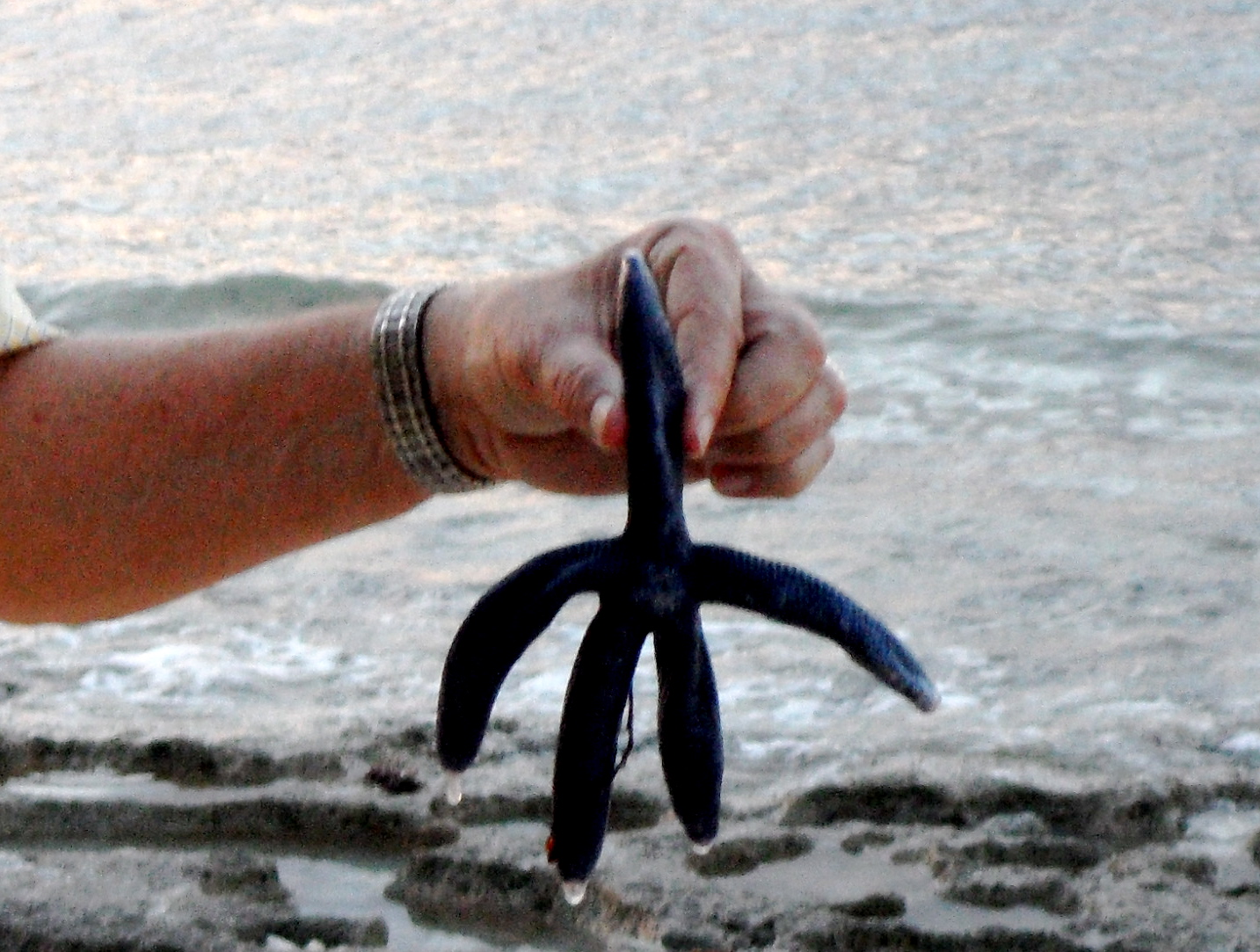
While with a group enjoying a coral beach exploration, I saw little fish and tiny crabs with bright green undersides in the tide pools, and one of the other senior missionaries found a blue sea star.  He brought it back for all of us to see, then flung it back beyond the reef, where it would have a better chance of survival than in a tidal pool when the tide was going out. 


The whitish liquid from the ends of this sea star’s arms was probably caused by the stress of being out of the water.

Then there was a truly special moment, when another couple showed us a hermit crab inside a shell.  They had been unable to pull the crab out of the shell, but they wanted to take the shell with them.  Call in the specialist – one senior missionary took the shell, and started whistling – a high, warbling, bird-like whistle – and what do you do know, the crab was coaxed out!  Another first for me!

And while not wild, something in plentiful supply – dogs.  We have been warned that most of the dogs here on the island are not friendly, and I will say that the night is filled with barking and baying.  But so far, the dogs I’ve met have been civil, and one particular dog was an excellent host.  He came and spent the evening with us on the beach near his owner’s hotel, even after we put the food away, and seemed especially fond of Jim, who sat down on the sand and gave him a good rubbing for about an hour.  We miss our own dogs, but this was a great doggy fix.

There are cats around, some domesticated and some feral.  But even the ones who live with families are pretty skittish, and it takes some real effort, and usually a few days of offering food scraps, to get a cat to trust you here.  And unless you want the cat to live on your back porch, you don’t do the food scrap thing. 

This is a young kiu bird - in English it's called a wandering tattler. Sounds like some children I know!  This has to be a cousin of a sandpiper – the long legs and the long beak just announce that this guy should be chasing sand clams along the beach, instead of looking for bugs in the grass (or standing in the shade of a flagpole on a sunny afternoon – he even looks like his feet are hot, doesn’t he?) I don’t know if they make any sound – I haven’t seen any of them singing yet. 

And this bird is called a red-vented bulbul, but I like the Tongan name better - a manufo'ou.  As soon as I saw this one, I thought, hey, there’s a cousin of a cardinal.  It has the same peaked cap, but is larger than a cardinal – about the size of an eastern mockingbird.  And it even has a flash of red and a splash of white, on the bottom and top of the back end of its body, just where the tail feathers begin.  These guys chirp and whistle all day long, and most of the night, too, when their mates are sitting on eggs.  And their chirp is similar to an eastern cardinal – Ch-ch-ch-ch-cheeerrruuppp!  No staying unhappy when you listen to them sing.  These are the birds we see most often. 

And my progressive friends will all be glad to know that every chicken on this island is free-range.  I missed getting a picture of the hen and her eight chicks crossing the road in front of our car the other day, but at least I got this handsome rooster at the roadside vegetable stand.  They don’t “cock-a-doodle doo” like the roosters I’m used to – they have a very wide, wobbly vibrato that makes them sound like sirens, especially at 4:00 in the morning! 

I for one am glad that there is such a variety of creatures on this planet.  Sure makes life more interesting and enjoyable – reasons to smile all day long.  And who doesn’t want a reason to smile?