Showing posts with label animals. Show all posts

Sunday, August 12, 2012

LAND OF WONDERS


Seems a man from Texas came to Tonga some years back, curious to compare farming techniques.  After spending a day on a Tongan “plantation”, the word for farm here, the Texan wanted to impress the Tongan with the difference in scale.  “This has been a wonderful experience,” said the Texan.  “But I want you to understand, it takes me an entire day to drive the perimeter of my ranch.”   The Tongan raised his eyebrows twice in acknowledgement.  “Oh yes,” said the Tongan, “I had a car like that once.”  (No offense intended, my Texan friends!)

Tonga is tiny, but it has its share of wonders.  And some of them are absolutely jaw-dropping. This tiny island nation, spread out over miles and miles of ocean, has many delights for the eyes, ears, noses, taste buds and fingers for those who will take the time to notice.

Let me remind you that if you added up all land of the 177 islands and islets that make up Tonga, you’d add up to a little more than four Districts of Columbia.  I live on the “big” island of Tongatapu, all 100 square miles of it – the size of DC and Arlington, Virginia put together. I have not seen all that this island has to offer, by any means.  But I have been awed by what I have seen.

To the east of Tonga, under the water, lies the Tonga trench, the second deepest point in the Pacific.  The sea floor here is the northeast juncture of the Australian and Pacific tectonic plates, and the Pacific plate is being driven beneath the Australian plate in a process called subduction.  Because of this process, there is frequent seismic activity in the area – we just had a 5.9 earthquake last week.  There are even underwater volcanoes being swallowed in this process.  I have been fascinated with the research going on that is documenting this dramatic event.  Here's a link to a news report from last November:


And we can visit the blowholes just minutes from our apartment and office, and be treated to a marvelous display each morning and evening.  From July to October, humpback whales frequent these waters, calving, nursing and tending their young.  We can see the whale spouts and flukes as these magnificent creatures surface, and now and then we are treated to a breach, when the whales jump out of the water, seemingly for the simple joy of doing it.  Mothers spend between 3 and 4 months here helping their babies grow, before they return to the Antarctic waters rich in krill, their main food supply.  The baby whales nurse and grow tremendously during these few months, but the mothers do not even feed.  Wow.  My biggest frustration is that the whales are always a few seconds ahead of my camera!


Closeup of a blossom cluster

My favorite perfume on the islands is the frangipani tree.  Even when this tree drops its leaves for the dormant season (I can hardly call it winter here), it keeps blooming, and the  palm-sized blossoms, either pink or yellow with white, have a gentle aroma that just makes me smile.
This tree is about 10 feet high, and loaded with pink blossoms.


This island of Tongatapu is proof to me that God has a sense of humor.  Even though this island is only 30 miles end to end, there are five different kinds of potato that grow here.  And one of them grows on a tree!  From “millimeter potatoes” that I grew up calling new potatoes to purple sweet potatoes to breadfruit (youth basketball-sized globes that indeed grow on trees) to the two-foot long “ufi” (OOO-fee), like in the picture.  Tongans can always get their starch, to go with their “lu”, corned beef wrapped in a thick, spinach-like leaf – a favorite at most family gatherings. Garden vegetables here are quite pricey, but you can always feed your family a kind of potato, and fill those empty stomachs. 


This is a screen capture of a Google Earth image.  
The Pigeon’s Doorway, or Hufangalupe in Tongan, is what happens when water, wind and erosion combine on the face of a cliff.  What looks like a sinkhole from the air is actually a chasm carved by the waves, with a natural bridge of rock and soil over a huge opening where the ocean rushes in.  

Low tide under the natural bridge formed by
 the rocks that  the waves can't reach.
The limestone cliffs are over 100 feet tall at the ocean’s edge, and even on the calmest day the waves crash with a humbling energy against the rocks. The volume is impressive; you have to walk away from the cliffs’ edge a good ways before you can talk to each other. 


Free-range pigs - a common sight here!
And everywhere, everywhere, are the birds, the fruit bats called flying foxes, the crickets that chirp every night year round, the varieties of floating jewels called dragonflies, the timid dogs and cats that scavenge for food, the free-roaming sows and piglets filing across the street – Tonga is a wondrous experience for me.  Can you blame me for wanting to stay forever?

Thursday, December 1, 2011

WILD KINGDOM


The plant and animal life here in Tonga is fascinating.  This tiny island, at its longest 30 miles by no more than 5 miles wide, has a remarkable number of wild animals.  Granted, most of them are small – bugs and birds – but they are all intriguing.  There are 7-inch long poisonous millipedes (one was on my back porch a few days ago, enjoying the water as my washing machine drained) and there are the smallest ants I have ever seen – if they’re not moving, you really don’t notice them.  Scout ants are constantly inside the cupboards – if you don’t keep your food in jars and double-sealed bags, they’ll gain access.  But hey, it’s just extra protein, right?  Ha! I’ll let you know when I get open-minded enough to eat bugs – not yet.

There are slow-moving, graceful wasps, beautiful butterflies and dragonflies, and plenty of mosquitoes, too, but I don’t seem to itch from a bite as long as I did in Colorado.  And they’re not big enough to carry you off, like they are in Michigan!  A swarm of termites hatched the other day, creating a cloud outside our little chapel/classroom – wooden furniture needs to be sprayed monthly in order to survive here.  And the humidity makes metal rust quickly, so there’s always something to be done!

One of the other senior missionary couples grabbed us the other night, and drove us up the road about a mile.  Hanging from a large, mostly-bare tree were about 100 fruit bats – flying foxes.  The tourist brochures send bat-seekers elsewhere, but here was a colony of bats just getting ready to launch in the evening sun.  We stood and watched them for about 20 minutes, circling and landing back on the trees, and stretching their wings and preening while they hung from the seemingly too-fragile branches.  It was wonderful.  I have seen these creatures in captivity, but never before in their own wild element.  They are meticulously clean, and apparently very social creatures.  They eat only fruit that is a little overripe, and there’s plenty to share here.   And who could resist an “awwww” when you see their faces?  Now when I look up in the sky and see a large set of wings flapping, I smile with anticipation that it might be a flying fox – and it usually is.  (Haven’t yet seen the national rugby mascot, the sea eagle.)

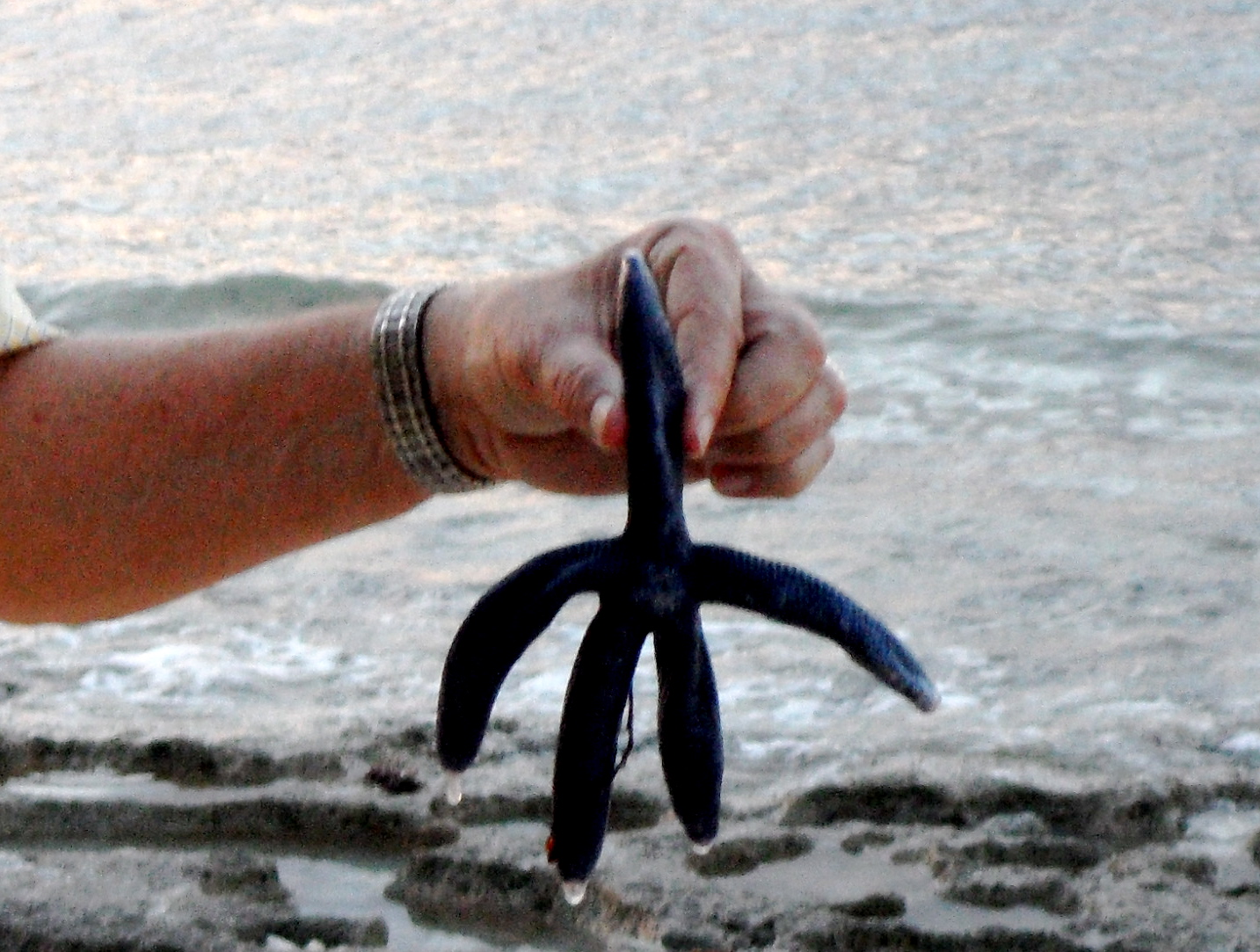
While with a group enjoying a coral beach exploration, I saw little fish and tiny crabs with bright green undersides in the tide pools, and one of the other senior missionaries found a blue sea star.  He brought it back for all of us to see, then flung it back beyond the reef, where it would have a better chance of survival than in a tidal pool when the tide was going out. 


The whitish liquid from the ends of this sea star’s arms was probably caused by the stress of being out of the water.

Then there was a truly special moment, when another couple showed us a hermit crab inside a shell.  They had been unable to pull the crab out of the shell, but they wanted to take the shell with them.  Call in the specialist – one senior missionary took the shell, and started whistling – a high, warbling, bird-like whistle – and what do you do know, the crab was coaxed out!  Another first for me!

And while not wild, something in plentiful supply – dogs.  We have been warned that most of the dogs here on the island are not friendly, and I will say that the night is filled with barking and baying.  But so far, the dogs I’ve met have been civil, and one particular dog was an excellent host.  He came and spent the evening with us on the beach near his owner’s hotel, even after we put the food away, and seemed especially fond of Jim, who sat down on the sand and gave him a good rubbing for about an hour.  We miss our own dogs, but this was a great doggy fix.

There are cats around, some domesticated and some feral.  But even the ones who live with families are pretty skittish, and it takes some real effort, and usually a few days of offering food scraps, to get a cat to trust you here.  And unless you want the cat to live on your back porch, you don’t do the food scrap thing. 

This is a young kiu bird - in English it's called a wandering tattler. Sounds like some children I know!  This has to be a cousin of a sandpiper – the long legs and the long beak just announce that this guy should be chasing sand clams along the beach, instead of looking for bugs in the grass (or standing in the shade of a flagpole on a sunny afternoon – he even looks like his feet are hot, doesn’t he?) I don’t know if they make any sound – I haven’t seen any of them singing yet. 

And this bird is called a red-vented bulbul, but I like the Tongan name better - a manufo'ou.  As soon as I saw this one, I thought, hey, there’s a cousin of a cardinal.  It has the same peaked cap, but is larger than a cardinal – about the size of an eastern mockingbird.  And it even has a flash of red and a splash of white, on the bottom and top of the back end of its body, just where the tail feathers begin.  These guys chirp and whistle all day long, and most of the night, too, when their mates are sitting on eggs.  And their chirp is similar to an eastern cardinal – Ch-ch-ch-ch-cheeerrruuppp!  No staying unhappy when you listen to them sing.  These are the birds we see most often. 

And my progressive friends will all be glad to know that every chicken on this island is free-range.  I missed getting a picture of the hen and her eight chicks crossing the road in front of our car the other day, but at least I got this handsome rooster at the roadside vegetable stand.  They don’t “cock-a-doodle doo” like the roosters I’m used to – they have a very wide, wobbly vibrato that makes them sound like sirens, especially at 4:00 in the morning! 

I for one am glad that there is such a variety of creatures on this planet.  Sure makes life more interesting and enjoyable – reasons to smile all day long.  And who doesn’t want a reason to smile?