Showing posts with label children. Show all posts

Tuesday, March 19, 2013

I WILL STAY ON THE PATH


When Sister Rosemary M. Wixom, the General Primary President, was here a few weeks ago, I had the great blessing of witnessing her interaction with some Tongan Primary children.  About 60 of them sang to her in both Tongan and English, and she left the podium to go down close to the children and spoke to them personally.

She spoke with a few children individually, asking for responses to questions or for volunteers to tell her something important they wanted her to know.  She asked the group some questions for the entire group to respond to, as well.  She asked the children, “Raise your hands to show me this – how many of you want to go back to live with your Heavenly Father?”  Of course, every single hand in the little Primary choir went up.

Then she asked, “How many of you want to go there alone?”  No hands.  The children just sat there.  Sister Wixom let the silence sink in for a few sentences, and then she turned to the adults in the room.  “It is our job to live so that we can go back to Heavenly Father WITH these children.”

Many years ago, I had a very cherished interchange with some young students who exacted a promise of me to continue to live my life in such a manner that I could help them.  Because of Sister Wixom’s visit, I had a second, with the Primary children in my little ward.

Sister Wixom taught the children how to say “I will stay on the path back to my Heavenly Father” in American Sign Language.  They practiced it many times with her, and she made points to the children and to the adults in the room each time they practiced it. So a few days later in Sunday Primary, most of the older children still remembered the signs, and we reviewed it together.

We practiced the signs, and we talked about how to stay on the path.  We talked about the importance of obeying the commandments, and staying true to our promises and covenants.  And at the close of our conversation, I looked at each child in the room, and asked, “Will you promise me today that you will stay true?  Will you stay on the path?”

“Yes,” came the chorus.
“Even when it’s hard?” I asked.
“Yes,” came an even firmer reply.
“Even when you’re sad, or you’re angry, or you’re feeling like no one loves you?”
“Yes, yes, yes.”

In return, I made a promise that I would remember their names in my prayers.  I told them that if it was possible, I would like to come back to Tonga in 15 years and find them being true to the gospel – serving missions, marrying in the temple, serving responsibly in callings, helping others find a testimony. 

I have two wonderful sons.  I am not yet a grandmother, but I have at least 50 souls to pray for every night - among them the much-loved students who exacted my promise those many years ago, and now, these precious Primary children.  If the Lord will allow me to keep my wits about me, these children will be in my prayers for many years to come.  And praying for them will be my best motivation to stay on the path, too.

Sunday, December 9, 2012

SEASON OF NEW GREEN


The green is still that new, "spring" green, even under the
trunk of a fallen tree. 
It is spring here in Tonga.  The grass is that bright shade of “new green”, and the crops are maturing at an incredible rate.  We have green mangoes – so called because they never really turn pink – and golden pineapples once again.  And I’m already salivating because the avocadoes are coming on the trees.


Outcroppings like these can be over very shallow or very deep water,
and the beach is very different at high or low tide.
We enjoyed exploring to a new place the other day, and watched a Tongan family play in the water at a beach that was only about 40 feet across, framed by coral outcroppings.  The parents and five children (ranging in age from about 16 to 3)  jumped into the water, raced the waves up and down the beach, swam through the surf, and tried (and succeeded) to catch a few sea creatures.  One boy caught a  creature of some kind – it had a shell, but I couldn’t tell exactly what it was.  He was quite excited to put it on the wet sand, watch the creature flop toward the water, then grab it again and move it back up on the shore.  He finally wrapped the creature in some aluminum foil, and took it home with him when the family left.  The crustacean will probably become part of the family’s dinner tonight.


The most fascinating moment when the youngest daughter, about 8 or 9, finally freed a crab from an abandoned net the family had dragged out of the water.  She took it over to her 16-year old brother, who talked to her about it for a few minutes. Then she handed him the crab, which surprised me, because she had not let any of her other brothers take the crab.  But she willingly handed the crab over to her oldest brother, and he in turn lobbed the crab back into the water.  Then the family began gathering together, and decided it was time to go home.  Within minutes the beach was quiet, as the last of the family waved goodbye to us.  The rest had already disappeared into the mangroves.

I was fascinated with the conversation and the actions of these two siblings, because they demonstrated to me a change in traditional family dynamics here in Tonga.  Most of the time authority rules here; fathers are feared more than loved, older siblings get their way at the cost of the tender feelings of younger siblings.  But not this time.  This older brother chose to teach his sister about this crab.  Perhaps he explained that it was not edible, or that it was too small.  In any case, her accomplishments and tender feelings were honored, and she in turn honored his greater knowledge, and allowed him to rescue the crab and return it to its saltwater home.  And both she and her brother were happy.  It was like watching a bit of “new green” in family relations here. 

We sat under a mangrove tree like this one.  
What a lesson.  It was an honor to watch this family enjoy each other’s company today, parents and siblings taking turns helping the little three-year old get used to the strong surf, younger brothers and sisters cartwheeling and flopping in the sand, and the older ones jumping into the water from the outcroppings.  Jim and I were blessed to be witnesses as this family shared a simple yet profound expression of love and joy in each other’s company.  As the season of spring continues, it is wondrous to watch the growth in the people of this tiny island.  

Wednesday, September 19, 2012

LEARNING IN ADVERSITY


Imagine yourself for a moment as an 18-year old boy, named Pahulu.  You have experienced debilitating pain in every step for months, yet the doctors have no idea what is causing the pain.  You have managed to get a pair of crutches, even though they are few and far between in this country.  That helps you get around the house, but you don’t have the endurance for much more than that.

Oh, and you’re not living with your own family.  Your parents have thrown you out of your family home, because you joined the Mormon Church.  You have been taken in by Lopeti and Luseane, a generous young couple who have no children of their own, but who share their home with you and six other young adult men whose circumstances are not so different from your own.  You get wonderful love and support from everyone around your, yet your heart longs for your own family.

You long for them, but your own family feels only animosity towards you.  When Lopeti informs your parents of your undiagnosed, painful condition, their reaction is to go to the family cemetery and dig your grave.  Then when you do not die in a short time, the family turns to prayer – praying that you will suffer greatly, because of your choice of religion.  Lopeti chides your parents:  “Where is your faith?  Why do you not hope for your son to be healed?”  Your parents have no answer.  But you hang on to Lopeti’s promise to your parents: “I will stand by him and support him with all my heart no matter what happens.”


This house is typical of most Tongan homes. 
Lopeti and Luseane both work long hours for meager pay, and you try to be as independent as you can, though you know you take a lot of their time.  You watch the other young men in Lopeti’s and Luseane’s home.  Joseph rises before dawn each morning to cook food to sell, so he can finance a full-time mission for the Church.  The others, David, Jeffry, Liva, Maikolo and Ensini, do what they can to bring in some money to help defray the cost of their meals.  Lopeti and Luseane do not expect rent; this home is for all nine people, as long as it is needed.  Lopeti says, “It’s hard to be a father,” and your mind completes the sentence:  “especially trying to be a father to sons who have already been raised by someone else.”  Yes, when something gets broken in the house, all of you still stiffen in expectations of being beaten, but Luseane simply says, “Let’s get a broom and clean it up.”  You hear Lopeti say frequently that “hands are for blessing, not beating,” but it’s going to take a while longer to stop being fearful when accidents happen.  Not being beaten, not being blamed when things go wrong, is still a new experience for all of you.


The Mormon chapels in Tonga are modest, but sturdy. 

Because you don’t want to be discouraged by the malice of your birth family, you have turned off your cell phone and given it to Lopeti.  Better to have no contact than negative contact, at least for now.  Perhaps their hearts will soften in time.  And Lopeti strengthens you many times a day, reminding you to seek solace in prayer, to remain faithful and strong in the face of this adversity, to forgive your family for their ill will towards you and try to feel only love for them.  You receive a priesthood blessing at the hands of a senior missionary, which provides comfort and strength, if not healing.  Now you can find peace even in pain, because you know in your heart that you are safe here, you are protected and loved, and you will be the better for this experience.  So you smile, and your face is an expression of calm assurance, your demeanor one of acceptance and endurance.

You know that Lopeti is a man of God, for he has shared with you a dream he had some years ago.  His father also opposed Lopeti’s choice to join the Mormon Church, and died a few years before Lopeti served a mission.  In the missionary training center in Provo, Utah, Lopeti dreamed he saw his father dressed in rags and in prison. His father pleaded with him to free him:  “Only you have the power and authority to free me.”  After a long conversation with the President of the missionary training center, Lopeti went to the Provo temple and did vicarious work for his deceased father, to provide him the opportunity to choose, in the next life, which path to take.  A few nights later Lopeti dreamed of his father again, but this time his father was dressed all in white, and had tears of joy in his eyes as he held his arms out to his son, saying “thank you, thank you.”  That experience helped Lopeti build his life around serving others.  Not for the first time, you close your eyes in gratitude for Lopeti and Luseane, realizing how blessed you are to be the object of their service.  You echo the words of Lopeti’s father:  “Thank you, thank you.”

Lopeti, Luseane, with Pahulu (seated) and two of the other young men in their home. 
You smile as you think of the way Lopeti and Luseane have applied one particular scripture in their lives:  “Inasmuch as ye have done it unto one of the least of these my brethren, ye have done it unto me.”  (See Matthew 25:40.) And you hope you will be healed, so that you can serve in the same way that these two wonderful people do.  You hear Lopeti’s words echo in your ears: “When you see someone in need, you’ll feel the Spirit prompt you.  That may be Christ right there, waiting for you to serve Him.”  And you understand more fully how to be Christlike, because you see it around you every day.

Monday, July 30, 2012

I TRUST YOU


I am leading a course in effective teaching, and last week’s class included a discussion on making students feel safe in our classrooms.  I want to share one story shared with us during this part of the course.


I will call the student Siaosi (See-ah-OH-see).  He is in Kili’s homeroom, and she has a delightful relationship with her students.  She is definitely the boss of her classroom, but her students look forward to time in her room.  Her homeroom students begin the day with a scripture, a hymn, and a prayer.  Kili watched through the beginning of the school year (remember, school begins in January here), and after a few months, she noted that Siaosi, who is not LDS, was comfortable with the routine and began asking Siaosi to participate in the devotional routine.  He accepted, and contributed well to the good feelings in class.


Well, a while back, Siaosi missed three days of school.  When he returned, he explained that he had been in jail.  He had been waiting for a bus to school, and some boys from another school started teasing the Liahona boys, and the teasing turned to bullying, and the bullying resulted in a fight.  Even though Siaosi had been on the sidelines, he had been taken in by the police and kept overnight.  
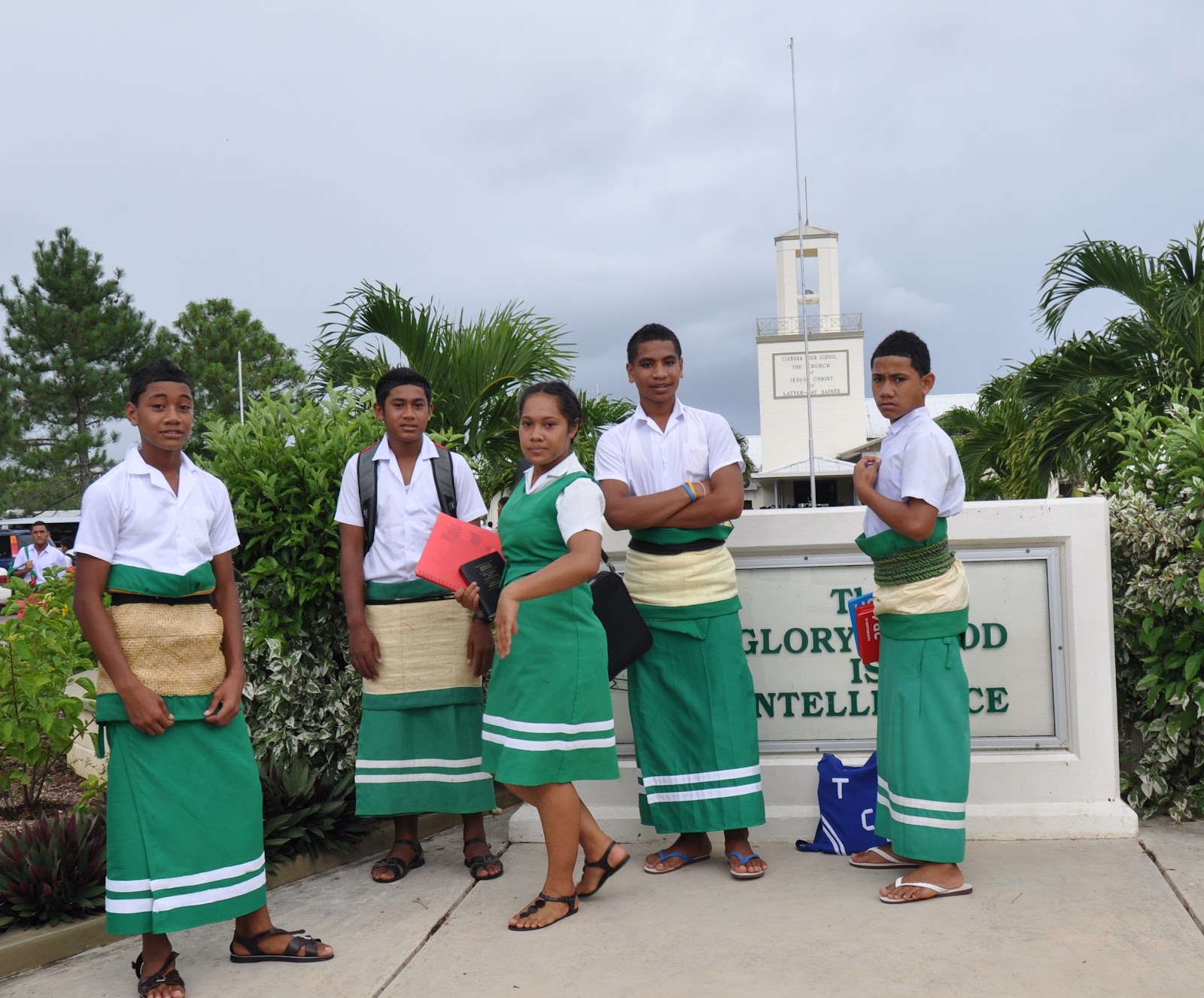
Bringing 1200 students to school on privately-owned,  unscheduled buses means a transportation headache for anyone, even under the best of circumstances.  Throw in some teenaged impulsivity and you have an even larger problem...

A lot of students get transported to and from school in the open air!


When he was released, he walked to his home, only to find his clothing in a pile outside the front door. His mother, talking to him through a closed front door, told him she didn’t want him at home any more, because he would be a bad influence on his younger brother.  


Siaosi found another place to stay, and continued to come to school.  After a few weeks, he asked Kili for help.  “I trust you,” he told her.  After a long discussion, he picked up the telephone, and dialed his mother’s number.  “Hello, mom.  It’s me, Siaosi.  I just called to tell you I love you and I miss you.”  He hung up the phone softly - his mother had said nothing. Kili assured him that she would continue to support him, and promised him that she would help him find a way to make things better. Siaosi left her classroom encouraged by her words and actions.


A few more days went by, but then one morning Siaosi stopped in to whisper to Kili, “Thank you very much.”  No further details were given – the class was about ready to start and both teacher and student were unavailable.  But when all the classes took their lunch break at 1:00, Siaosi came back to Kili’s classroom to explain:  “I’m back home!  My mom let me come back home, and everything’s better.”


Students who feel safe in Kili’s room know that she will do everything I her power to keep them safe, physically, intellectually, and emotionally.  What does that say about effective teaching?  What can I do for one student today, for one person, to make them feel safe, to make them tell me, “I trust you?”  I think those are the three most powerful words a teacher can ever hear.

Monday, June 11, 2012

CANDLES WILL SUFFICE


So the electricity in the tiny Tongan home was turned off.  Husband Taniele and his wife Mele, who lived on one of the outer islands, were undeterred.  Neighbors gossiped about them, and even confronted them:  “Aren’t you ashamed to bring your children back here for the summer?  You haven’t managed your finances properly.  And now your five children will come back to a home with no electricity.  They will have to use candles to read, and you must now cook outdoors, over an open fire!  You have not been wise parents!"


S

The neighbors’ words and looks had the same kind of impact as beating a coconut with a palm leaf; Taniele and Mele smiled in return.  “We do not care about the electrical power,” said Taniele.  “I have worked hard to catch the crabs near the cliffs of our island, and I have saved enough money to pay for all five of our children to return home for the summer, after living at school all year.  All five of our children will have money to pay for their ferry ride when school ends this month.  If I must sacrifice our electrical power, is that not worth it?”


“We may not have electrical power, but we will have our children with us for a few months,” continued Mele.  “I will gladly cook for them over an open fire.  And they will help me, and they will help their father with his fishing.”


Taniele searched the faces of his neighbors.  “Electrical power is nice to have, but it is not a necessity in my life,” he said.  “When my children arrive home, I will light a fire in the yard.  I will gather them around the fire.  And I will teach them again how they should light the world around them, using the light of their own knowledge.  I will teach them to share their light, to lift those around them, to provide clearer understanding for those who are confused, to provide confirmation for those who doubt, to provide a pathway for those who are lost, to provide support for those who have fallen, to provide illumination for those who are searching. And I will remind them that their first duty is to provide light for each other – the older children for the younger, and sometimes the younger children for all of us.


“Then, when I have taught them, I will give each of my children a candle to take to their beds. They will certainly tell me their candles offer only a poor light, but I will remind them that it only takes a few candles to light an entire room.  Together, our five candles will light our way to our home.  And once inside the room, we will kneel in prayer, to offer thanks for their safe return to our home.  And the candles will remind us of the source of all light and knowledge, our Heavenly Father.  And they will remind us of our Savior Jesus Christ, who has lighted our way so that we may return to our Father.  And we will love the light, and seek for it together, so that we may live in the light together.  And when my children are grown, their light will be stronger than mere candles – they will be bright lights to each other, to their friends, to their husbands and wives, because they will carry within themselves the light of the Spirit of God.”


Taniele and his wife Mele are typical of the faithful Saints in Tonga, who realize that using the power within ourselves to benefit others is eternally important, while other types of power are just earthly conveniences.  Their perspective, their faith, and their humility has affected me deeply.  I hope this story has a deep effect on you, too.  Remember what is truly important.