Showing posts with label mission. Show all posts

Wednesday, July 3, 2013

ONE MIRACLE AT A TIME

Elder Makasini, a young Tongan American, sat stunned in his seat.  Who would have thought he would ever have the chance to keep his promise to Elder Hamala?

Months before, when Elder Makasini first received his mission call to leave his home in California and travel to Tonga to preach the gospel, one of the full-time missionaries in his ward had pulled him aside.  Elder Hamala, who had grown up in Tonga and was serving his own mission in California, told him very earnestly, “I need you to make me a promise.

“Promise me that if you ever get to Maufanga, and you find my mother, you will bear your testimony to her,” he requested.  “She’s a devoted Catholic, but she’ll listen to you, and maybe your testimony will touch her heart.”

Elder Makasini promised he would do that.  But time went by and Elder Makasini served in other villages in Tonga, and forgot his agreement with Elder Hamala.  Then one day he went on a companion exchange with another missionary, and a couple of ward leaders each took a young full-time missionary to visit the homes of less-active and part-member families.  Elder Makasini found himself in the home of a widow.  “My Tongan is still not very good,” Elder Makasini admits.  “But about 15 minutes into the conversation, I realized that this woman’s name was Hamala, and that she had a son who was a member of the Church.” 

Elder Makasini turned to Mrs. Hamala, and asked, “Is your son serving a mission right now?  In California?”  Both answers were yes.  “I know your son.  And he asked me to bear my testimony to you if I ever met you.  Would you allow me to do that?”  Again, the answer was yes, as a mother who missed her own son dearly listened to the words of a stranger, explaining to her why her own son left her for two years, why Elder Makasini had left his own family in California to come to Tonga, and the importance of the message he brought to her.  

Reflecting on the experience, Elder Makasini shares, “I knew the Spirit was strong that night.  I felt it, and I hoped that she felt it.  I bore my testimony, we all wept, and that was the end of the visit.”

Fast forward about 5 months.  Elder Makasini now serves in an area that includes the Nuku’alofa Temple, and was walking along the sidewalk across the street from the temple one day when he heard a voice call out, “Makasini!  Makasini!”  The voice belonged to Elder Hamala. They ran to each other and embraced.

“Hey, I didn’t know you were home!”
“Just got home a couple of weeks ago.  How’s your Tongan?”
“Oh, bad, really bad.  But I keep trying.”
“That’s good.  You’ll get it.  Keep trying.”
“Hey, I found your mom a few months ago, and bore my testimony to her.”
“I know.”
“Really? What, did she tell you about it?”
“That and more.”
“Well, tell me about her.  Where is she now?”

Elder Hamala pointed his thumb over his shoulder at the temple.  “She’s in there, doing some baptisms for the dead.  She was baptized months ago.”

Elder Makasini and Hamala embraced once more, this time out of sheer gratitude for the power of the Holy Ghost, which had carried Elder Makasini’s words to the heart of Elder Hamala’s mother.  She in turn recognized the power of that witness, and acted upon it.  One miracle at a time, the Lord’s work continues here in Tonga.


Monday, April 29, 2013

LAND OF LIGHT


Living in the tropics where days do not shorten and lengthen as much as they do in more temperate latitudes, I have come to rely on the rhythms of the sun to measure my day.  If I wake up and the sun is above the trees, I know I’ve overslept.  But if the sky is just beginning to brighten, then I know I have time to get ready for the day without rushing. 
Sunrise in my back yard.  Yeah, it's a hardship assignment here.

The other night we ate dinner with friends at a restaurant, watching storm clouds approach the northern shore of the island.  Their dark, heavy appearance made us willing to hurry through our dinner and get back into the car, to get home so we could be safe.  We knew that the clouds would bring only rain, not high winds, but the foreboding nature of the clouds was enough to make us concerned.  We had no care to stay and experience the coming rains, as announced by the clouds.  So, we hurried back to enjoy the storm from the safety of our little home, turning on electrical lights to fend off the darkness of the clouds and rain.  As I sat and pondered in our home, some very loosely connected thoughts came to me:

1.  I have heard darkness defined as “the absence of light”.  That definition is used in black and white photography, but I also see it as a metaphor for my life.  The light of knowledge, the light of truth, the light of understanding – my purpose is to seek for light, and then use it to guide my decisions.  I know the standard of light - the quality of light I want to develop in myself.  I must guard myself against absenting myself from the light, and make my choices based upon the quality of light each alternative will provide.  

The other day I was working with some of the leaders of the boys' dorm, and we talked about the word "praiseworthy."  We talked about making decisions based on the praiseworthiness of each choice - which of two good things would you rather be congratulated on?  Which of two (or more) good things would you want your parents, or your leaders, or the Savior, to see you doing?  That is the praiseworthy test.  

One teacher doing a presentation in one of the
classes I teach after school.
2.  The light of education has been easy for me to seek. I have a deep love for the light of learning.  I appreciate the new understandings I gain when I search, and for the new understandings I can impart to others as I teach.  As I work with teachers here in Tonga, I love to watch the light in their faces as they master a new skill, or comprehend a new concept.  But there is so much more for them, and me, to learn.  May we have enough light to understand how to accomplish our worthy goals.

My "tall sister" and her daughter - I am the short sister!
3.  Light is within us all.  I need to remember that.  As I work together with others, I need to remember to bask in the light of others, and absorb the light of understanding - exemplified by the woman in this photo, who asks me almost
as many questions as I ask of her;  the light of patience, exemplified by a teacher who sat there with me for eight hours while we tried to get the computer to cooperate (eight hours - seriously????); the light of love, exemplified by Lehua (at lower left), one of the dorm girls who I have been blessed to know.  When I allow myself time to absorb light from others, I can do more than reflect the light of others – I can become a stronger source of light for others. 


Whether I seek physical sunlight, or the light of education, or the light of love and understanding, or even the light of Jesus Christ, the benefits are the same: increased happiness and capacity.  And isn’t that what we all want in life?


Wednesday, April 17, 2013

TINY STORIES

Just a crazy quilt today of pictures and thoughts.  No special connections, no "moral of the story" - just a hodgepodge.

This is a picture of a semi-traditional Tongan home.  It's probably about 12 feet wide by 6-7 feet deep.  Most of the more traditional homes have only two rooms - parents' sleeping room and a common room. All the cooking is done outdoors, on an open fire, and bathroom needs are met by hand-dug latrines and buckets of water.  The shutters, closed against the rain in this picture, can be propped open to allow for ventilation.


This house is more indicative of how most people live in Tonga:  a simple, concrete structure with four or five rooms (common room, parent bedrooms, boy's bedroom and girls' bedroom, perhaps a room for extended family).  The corrugated metal fencing around the yard is to keep the pigs out of the yard, so it's called a pig fence.  This house even has a catchwater system, to store rainwater for household use in the big cement cistern to the right.  The smaller green cistern to the left holds treated water, delivered to the house, for drinking and cooking.  


This is a picture of a missionary, standing beside a child who in my book is an expert fisherman - he caught this small leopard shark with his bare hands.  Not bad for a 9-year  old boy, eh?  "Hey, mom, I got dinner for all of us!"  Families are often seen wading through the waters at low tide to harvest shellfish and urchins to eat - and my goal is to get a picture of a pig in the water, rooting for urchins!!!


This is a typical scene on the road.  You can see whole truckloads of students being delivered to the school here each morning - people find a place to sit, on the corners of the truck bed walls, or standing and holding on to the frame behind the cab window, or just lying down in the bed of the truck.  Don't panic, though, most of the time they're holding on very well, and the trucks rarely go more than 30 mph!


This is John (in Tongan, Sione = say See-OH-nay), one of our security guards here at Liahona.  Our school colors are green and white, so someone found these shirts and bought them for the security guards.  I have to smile when I read the pocket tabs, though:  Homeland Security.  Without going into detail, let me assure you that security at Liahona is much more relaxed than any security system I've ever seen anywhere else.  But we don't need a lot, either.


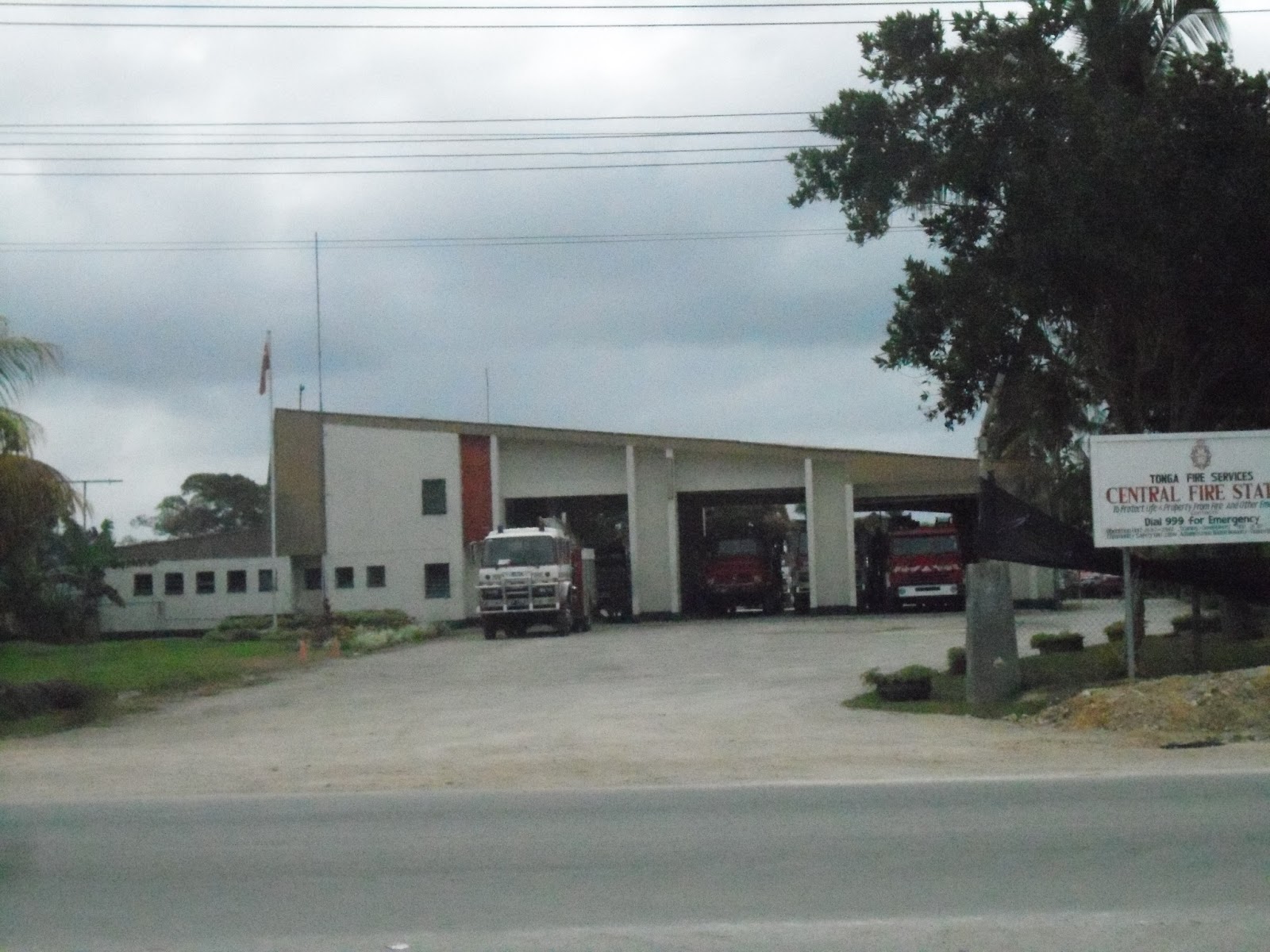
This is the fire station here.  And by "the fire station", I mean THE fire station.  There's only one in Tonga.  They stay busy!  They have a couple of small tank trucks and a pumper.  Does anyone know a multi-millionaire who would be willing to donate a couple million dollars to build and equip a second station on an island of 70,000 people?


The next picture is just so you know we aren't deadly serious all the time.  This was a mock trial at our recent principals' conference - English powdered wigs and all - charging principals with (shock and horror) making improvements to their educational programs!!!  Turns out they were all guilty, and each was sentenced to eating a 24-ounce chocolate bar at one sitting!


This last picture shows the dais built for the King of Tonga when he came to hand out diplomas at graduation.  This temporary structure was built out from the stage in the school gym/auditorium, and then covered in traditionally woven and painted mats.  The different weaves, patterns and styles of decorating reflect the different clans on this and some of the other islands in Tonga.  But the thing that amazed me most about the whole graduation ceremony was that students climbed up the steps at the right, received their diploma from the king, and then BACKED DOWN the steps again, because it is disrespectful to turn your back on the king!  


Life in Tonga is simple, unstressful, and slow.  And I am learning to appreciate that.

Wednesday, October 24, 2012

UNIQUE EXPRESSIONS OF LOVE


Every culture honors its dead in unique ways.  Tonga is no exception.  


Tonga is an island formed by coral pushed up from the seabed.  So when you dig, you don't have far to dig before you hit solid coral.  As a result, most graves are created by creating frames for raised mounds.

Whether by forming a concrete frame or by laying blocks, graves are clearly defined by borders.  And the grave markers you see are not what most people are used to:  Here, where natural stone is incredibly expensive, families use fabric and wood.


The marker of choice is a quilt.  It's far too warm, most of the year, to consider using a quilt on a bed, but somehow quilts have become quite popular as beautiful grave markers.  This quilt takes the names of a husband and wife and frames them with depictions of the heilala flower, a tiny flower unique to Tonga.  We have also seen graves lit at night by solar-powered lights, and even Christmas-style lights defining the border of a grave.


With no law to limit the location of graves, little cemeteries populate each village and indeed, many private homes, such as this one.  This family couldn't afford a concrete or block frame for the grave, so they built a natural fence around it.  The bushes provide color and some protection from the wind, and the posts and chicken wire keep out the animals.


Almost all graves are topped with sand.  And what happens when the wind blows it away?  We go get more.  The Tongan government is beginning to get concerned about illegal "sand mining", the theft of sand by the truckload (!) from coastal beaches.  This little island cannot afford to see its beaches eroded - we have few enough of them here to begin with.


 Families who can afford it can bury their relatives in style - here is a concrete frame topped with ceramic tiling, blackstone rock, and permanently placed pots for silk flowers. This is one of the few polished granite markers I have seen on the island.  But all graves are decorated with flowers, some with lace tablecloths, and some with hand-knitted afghans.  The dead are protected in a place of beauty.  There are a few LDS missionaries buried here, two who died in the Spanish flu outbreak in 1919 (the flu took two years to make it to Tonga, but it got here), and two others who died of other illnesses in the 1930s.  Their graves are tended, too.


And again, if the family can afford it, the grave is protected from the elements by a pavilion roof.  This will help the sand from being washed away in a sudden rain or a severe storm, and it will also keep the silk flowers from fading quickly in the hot sun. 


And it provides shelter for mourners.  When Tonga's king died last March, we got an extended view of the mourning traditions here in Tonga.  Students tended small fires surrounding the palace  all night long, the night before his body was brought to the royal tombs and the king's body was laid in its final resting place.  So, too, is the tradition with all deaths. A round-the-clock vigil is kept at the gravesite for anywhere between 3 and 10 days, (noblemen sat under a pavilion roof all day and all night 100 days for the king)and gifts are offered to the family of the deceased, although in a totally different perspective, the family of the deceased feeds visiting relatives for many days after receiving the gifts.


Even while tending a vigil fire, teens can be counted on to be cool!

The love and respect shown for one's elders here does not end at death.  Families are quite often seen cleaning up the cemetery, placing faded quilts with bright, new ones (out of respect for the dead, the old quilts are destroyed), and replacing and rearranging flowers.  Life may be a little more subsistence-oriented here, but the bonds of love stretch beyond death.  Tongans have that lesson to teach us all.  


Monday, October 15, 2012

ENDURE WITH LOVE IS THE CULTURE


The entrance to Liahona High School, dedicated by LeGrand Richards in 1953.
Pretty impressive by any standards.
Because of the wet climate, concrete sidewalks
 are everywhere.
Liahona High School in Tonga is an interesting mix of approaches and cultures, both in the way the organization is structured and in the way that people relate to each other.  One of the most British features is that it functions as a boarding school for about 80 of its students, who live in dormitories during the school year.  But imagine for a moment going to a boarding school, when the only thing you know that is bigger than your house is the ocean.  You come from a remote island, with very little exposure to even the still-developing standard of living here on the “big” island of Tongatapu.  
Major walkways are shelters from the hot sun and torrential rains,
regular features in the tropics.
So the shock of seeing concrete buildings, paved roads and sidewalks is dizzying, much less the shock of changing from family surroundings to a school of 1000 students.  Thankfully, the shared culture of the LDS Church helps students have an anchor here, and somehow they endure challenges that would have overwhelmed me at their age.


All students in Tonga wear school uniforms.
Liahona's colors are green and white, and
the two stripes represent the phrase
"by study and by faith,"the school motto.
Take Selu (SAY-loo) for example.  She comes from one of the other islands, a small island called Ha’apai (Hah-ah-PIE).  Her parents struggle to provide her with money for tuition, and since the kitchen provides two meals a day, breakfast and supper, Selu often goes without lunch, to save money.  But so do most of her friends, unless they buy some Ramen noodles or share a loaf of bread, two of the cheapest options for lunch at the store across the street from campus.

Selu spends the whole school year here, because her parents can only afford to bring her home on the ferry at the end of the school year.  So during the week-long breaks after each quarter and semester, she stays with relatives here on Tongatapu.  She misses her parents, especially her mother, but accepts the reality of spending ten months a year away from them. 

Selu has “dorm parents” who try to support her, but she is one of 40 girls in the dorm, so she has to create her own system of support.  Fortunately, the families here at Liahona spend a great deal of time with the dorm students.  Because of this support, and because of the way some of her teachers have extended themselves to her, Selu has found ways to succeed in school and be happy here.

Boys all over the Pacific islands wear a type of
wrap-around skirt. In Tongan it is called a tupeno.
Much cooler than trousers.
Sila (SEE-lah), one of the boys in the boys’ dorm, has had to work harder to find success.  He struggles with his English, since no one in his family speaks English at home, but he is expected to function in English during his classes.  He wants to do well, but is often frustrated with his lack of skills with the English language.

Sila’s dorm parents know that he is not the only boy who struggles.  So they have established a new system for the boys, assigning them in multi-age groups in rooms.  That way, 14-year old Sila has some older brothers in the dorm room with him.  These  older brothers have been trained to be guides and role models for Sila, and they take their responsibilities seriously.  Some of them serve as district leaders, a term borrowed from Mormon missions. District leaders are given the responsibility to make sure several room groups are functioning properly – that boys are where they ought to be, that problems are solved, that needs are addressed.  Sila’s  older roommates help him with his homework, teaching him the English words he needs to succeed.  They help him read his assignments, but they also spend ten minutes every morning and ten minutes every evening reading scriptures together.  They pray together, in their small groups, and all the boys in the dorm meet at 7 am every morning for a hymn, a prayer, and to share a spiritual thought. 

Saturday morning is not an opportunity to sleep in, either.  These dorm students are kept busy all week long.  Twice a month, before sunrise,  Sila and all the dorm students  go together to the LDS temple to serve by performing vicarious baptisms for dead relatives, to offer their deceased ancestors the choice of accepting the fullness of the gospel in the spirit world, while they await resurrection. The feelings and experiences they share about the chance to serve their ancestors are deep and frankly, too sacred to share here.  Just know that they come back from the temple happy.   


On the other Saturday mornings, Sila and the other  dorm boys go out to the Church farm and work “on the plantation”.  They usually spend about 4 hours there, then they are granted the afternoon off.  And at church on Sunday, Sila is surrounded by older brothers, who make sure he understands the lessons and feels the spirit of the messages he hears.  


I am amazed as I watch the dorm parents and their dorm students, that a couple, with children of their own, would be willing to take on an extra 40 children for ten months.  I smile as I watch the bonds of love that develop between these students and their dorm parents, their teachers, and the families who connect with them at church.  One of the “golden principles” of Tongan culture is love, and I see love in action every day here.  Life is challenging wherever you go, but because of their shared values, these teachers and students, these leaders and young men and women, are taking on the challenges together. 


Saturday, October 6, 2012

SERVE

Serve.
Serve, opposing disinterest and disobedience.
Serve, for your sake, and theirs.

Serve. Pray.
Pray for understanding and effectiveness.
Pray to rescue one, then one more.

Serve.  Pray.  Study.
Study your message and your people.
Study, so you can coach them to success.


Serve.  Pray.  Study.  Ponder.
Ponder your blessings and your readiness.
Ponder their challenges and impact.


Serve.  Pray.  Study.  Ponder.  Listen.
Listen to your experienced fellows.
Listen to the experts, and The Expert.


Then go serve.


Friday, September 28, 2012

THE COLORS OF TONGA

Another senior missionary in front of one
of our favorite flowering bushes.
There are seasons in Tonga, just like everywhere else.  That was one of the first lessons I had to learn - mangoes are not available year round, neither is any other fruit.  What?  The pineapples are finished?  Oh yes, this is an island, and since Tonga imports the highest proportion of food of any nation in the Pacific, we still have to wait until the next ship arrives to get the next shipment of milk, or wait for the rainy season to end to plant new tomatoes.

Keep in mind that the fence in front of the bush is about
6 feet high.  I love the way the bush just grew right
through the chain link.
The nice part about "winter" in Tonga is that you still get flowers, just different ones, like the yellow ones above or the purple ones at right.  I have no idea what most of them are called, but that doesn't keep me from enjoying their colors and their fragrances.  This purple bush at right is about 8 feet tall, and reminded me of some of the wild azaleas I used to see in the Shenandoah Valley of Virginia.

Flowers are planted purposefully, as well, and this amaryllis, which I photographed in March, finally succumbed to torrential rains in late  August.  The petals retained their delicate colors even after the blooms were on the ground.    This was in the garden of the LDS church across the street from us.


This picture at right shows the plantings in front of the mission office building - my favorite plant is the bush covered in tiny white blossoms.  Too bad the blossoms only lasted about 10 days.  But what  a wonderful fragrance!


And I love the way everything just grows together here.  In this picture there are at least five different plants sharing the same square foot of soil.  And they all seem to just thrive together.


The yellow leaves on the tops of plants are new growth -
the leaf comes first, then the chlorophyll! And yes, that's
a fallen coconut on the road.  They're everywhere.

The best plantings are in front of more established homes, where time has been the best ally to beauty.  I love this garden - this family has no other place than the front balcony to hang up clothes out of the rain, but the beauty of the front garden is not diminished by the realities of daily living.


And families are not shy about planting in front of their properties, either - this roadside fence is a simply a defining line between two gardens, rather than a boundary of property.


But the biggest winter surprise has been the amazing number of poinsettias here on this tropical island.  Red, white, and pink poinsettias are everywhere - some forming a wonderful hedge along the road, others just stretching up over other bushes (up to 8 feet in the air) and providing pops of red and white mixed in a hundred shades of green.


And then there are the giants.  This is another senior missionary hiding behind a leaf of kape (kah-pay), a root crop. A field of kape fills up a lot of space in a hurry!  And it invites certain senior missionaries to get silly...

The other giant leaves behind me are banana tree leaves.


The four of us snapped pictures, posing as Ninja Turtles and other such, but just so we could fit in some classics, here I am as the fairy queen from Shakespeare's "A Midsummer Night's Dream!" Tah-dah!


The greens, reds, purples, yellows, and other colors of Tonga delight the eye and serve to remind me of the endless variety of beauty in this world.  What a wonderful place - just like so many other wonderful places on this planet.  


Monday, August 20, 2012

FAREWELLS AND MIRACLES


We have had the pleasure of working with Elder and Sister Sanders, a senior missionary couple who accepted a humanitarian assignment here in Tonga.  Last March, we were a bit amazed (but not really surprised) when these two volunteered to take on a second assignment, that of inspecting, supplying and maintaining the 50+ little buildings called missionary quarters, where the young missionaries live here.  

Elder Sanders always wanted to get up-close and personal.
 Here he is inspecting a village water tank.
Sister Sanders knew better than to try to climb the
water tank ladder in a long skirt!

Well, the bad news is that Elder Sanders has developed some serious medical issues, and they have been sent home to Washington State.  There is a hole in our hearts, but we know that because of the events that have happened in the last week, the Lord has more in mind for this fine man and his wonderful wife.

Because of the limited medical care here in Tonga, the area supervisors flew Elder and Sister Sanders to New Zealand for a hospital stay and screening, to diagnose his trouble.  Our mission nurse, Sister Johnston, had been trying to get Elder Sanders to New Zealand for weeks, but he kept postponing the trip because of this project or that.  But when Elder Johnston got an abscess that would not respond to antibiotics, he was put on an urgent evacuation to New Zealand, and the mission president told Elder Sanders (and his wife) to go, too.  Tickets were purchased Friday evening for the flight to Auckland Saturday morning.

One of their few days off, at the beach.
While waiting in the airport in Tonga, the four missionaries met an LDS American couple who explained they had brought their adopted child, Tongan by birth, to meet his birth mother and experience some of the culture that was his heritage.  A pleasant conversation ensued, then everyone got on the plane and thought nothing more of the encounter.  They should have.

Arriving late in the evening, the missionaries decided to wait until morning to arrange treatment.  The next morning they found themselves at a nearby hospital emergency room, and the admitting doctor tried to explain that patients were not admitted on Sundays.  Then the supervising doctor came in to see what was going on.  The supervisor was, of course, the man the missionaries had met in the airport.  Turns out he works at three different hospitals, and “just happened” to be on duty at this particular hospital that morning.  Both men were quickly screened, and Elder Sanders was admitted as an inpatient. Miracle #1: check.

That evening, Elder Johnston found his abscess had begun draining.  This abscess, which had been in danger of going systemic and causing serious bodily harm within hours, simply began draining, once Elder Sanders was admitted. Miracle #2: check.

Elder Sanders’ prognosis is good.  The specialist in New Zealand has a brother who is exactly the kind of doctor Elder Sanders needs; and he just “happens” to practice in Elder Sanders’ hometown.  The Sanders, who started their journey home on Monday, had two appointments with doctors before they even got on the plane, and medical coverage assured from the Church.   Miracle #3: check.

The Sanders live in a rural area, and with the coming recovery period, Sister Sanders worried that because of the needs of their home, Elder Sanders would ignore doctors’ counsel to limit his activities.  Elder Sanders is a worker; he cannot sit for any length of time – he needs to be up and doing.  But Sister Sanders is very aware that in order for her husband to heal completely, he has to follow medical advice and avoid strenuous activity for three months.  Not easy for a man who has worked his own land and been a plumber for 40 years. 

Besides, before coming out on their mission, the Sanders rented out their house, and the contract is not up for another nine months.  Where would they live?

A couple of friends emailed the Sanders telling them they were going to travel to their daughter’s home, that they would be gone up to a year.  The Sanders looked at each other, smiled, and emailed a message:  do you want renters while you’re gone?  The return message began:  “The key is in the garage, the truck is ready to go, the cupboards are pretty empty – do you want our son to shop before you get here?”   And because these friends understand the power of pets during recuperation, they left their border collie behind, to stay with the Sanders.  Miracle #4: check.

Those are not all the miracles, but you get the idea.  The Lord takes care of His missionaries.  I believed that before, but now, with this experience, I have first-hand knowledge.  And Elder Sanders is not surprised.  He told us: “Why shouldn’t we expect miracles?  We’re out here doing what the Lord wants us to do.  We’re out here obeying our leaders, doing our best, and serving the people the way the Lord would serve them, if He were here.  So why should we be surprised when miracles happen?”

I am grateful for the faith and the faithfulness of those beside whom I serve.  It is hard on us to see the Sanders leave, but we trust that the Lord will continue to be mindful of this senior missionary, that his recovery may be complete, that he will be able to serve in other ways during the rest of his time here on earth.  And our friendship, our fellowship together, will continue to grow and develop.  Our paths may divide, but our hearts will remain entwined.  And we will continue to expect miracles.

The Sanders and our mission president and his wife.  


Sunday, August 12, 2012

LAND OF WONDERS


Seems a man from Texas came to Tonga some years back, curious to compare farming techniques.  After spending a day on a Tongan “plantation”, the word for farm here, the Texan wanted to impress the Tongan with the difference in scale.  “This has been a wonderful experience,” said the Texan.  “But I want you to understand, it takes me an entire day to drive the perimeter of my ranch.”   The Tongan raised his eyebrows twice in acknowledgement.  “Oh yes,” said the Tongan, “I had a car like that once.”  (No offense intended, my Texan friends!)

Tonga is tiny, but it has its share of wonders.  And some of them are absolutely jaw-dropping. This tiny island nation, spread out over miles and miles of ocean, has many delights for the eyes, ears, noses, taste buds and fingers for those who will take the time to notice.

Let me remind you that if you added up all land of the 177 islands and islets that make up Tonga, you’d add up to a little more than four Districts of Columbia.  I live on the “big” island of Tongatapu, all 100 square miles of it – the size of DC and Arlington, Virginia put together. I have not seen all that this island has to offer, by any means.  But I have been awed by what I have seen.

To the east of Tonga, under the water, lies the Tonga trench, the second deepest point in the Pacific.  The sea floor here is the northeast juncture of the Australian and Pacific tectonic plates, and the Pacific plate is being driven beneath the Australian plate in a process called subduction.  Because of this process, there is frequent seismic activity in the area – we just had a 5.9 earthquake last week.  There are even underwater volcanoes being swallowed in this process.  I have been fascinated with the research going on that is documenting this dramatic event.  Here's a link to a news report from last November:


And we can visit the blowholes just minutes from our apartment and office, and be treated to a marvelous display each morning and evening.  From July to October, humpback whales frequent these waters, calving, nursing and tending their young.  We can see the whale spouts and flukes as these magnificent creatures surface, and now and then we are treated to a breach, when the whales jump out of the water, seemingly for the simple joy of doing it.  Mothers spend between 3 and 4 months here helping their babies grow, before they return to the Antarctic waters rich in krill, their main food supply.  The baby whales nurse and grow tremendously during these few months, but the mothers do not even feed.  Wow.  My biggest frustration is that the whales are always a few seconds ahead of my camera!


Closeup of a blossom cluster

My favorite perfume on the islands is the frangipani tree.  Even when this tree drops its leaves for the dormant season (I can hardly call it winter here), it keeps blooming, and the  palm-sized blossoms, either pink or yellow with white, have a gentle aroma that just makes me smile.
This tree is about 10 feet high, and loaded with pink blossoms.


This island of Tongatapu is proof to me that God has a sense of humor.  Even though this island is only 30 miles end to end, there are five different kinds of potato that grow here.  And one of them grows on a tree!  From “millimeter potatoes” that I grew up calling new potatoes to purple sweet potatoes to breadfruit (youth basketball-sized globes that indeed grow on trees) to the two-foot long “ufi” (OOO-fee), like in the picture.  Tongans can always get their starch, to go with their “lu”, corned beef wrapped in a thick, spinach-like leaf – a favorite at most family gatherings. Garden vegetables here are quite pricey, but you can always feed your family a kind of potato, and fill those empty stomachs. 


This is a screen capture of a Google Earth image.  
The Pigeon’s Doorway, or Hufangalupe in Tongan, is what happens when water, wind and erosion combine on the face of a cliff.  What looks like a sinkhole from the air is actually a chasm carved by the waves, with a natural bridge of rock and soil over a huge opening where the ocean rushes in.  

Low tide under the natural bridge formed by
 the rocks that  the waves can't reach.
The limestone cliffs are over 100 feet tall at the ocean’s edge, and even on the calmest day the waves crash with a humbling energy against the rocks. The volume is impressive; you have to walk away from the cliffs’ edge a good ways before you can talk to each other. 


Free-range pigs - a common sight here!
And everywhere, everywhere, are the birds, the fruit bats called flying foxes, the crickets that chirp every night year round, the varieties of floating jewels called dragonflies, the timid dogs and cats that scavenge for food, the free-roaming sows and piglets filing across the street – Tonga is a wondrous experience for me.  Can you blame me for wanting to stay forever?