Saturday, December 17, 2011

Look at Me, I'm Smart!

The very modest building where we attend church.
Last Sunday in our adult Sunday School class, our discussion was interrupted by our amusement at the behavior of a three year old girl, whom I will call Lia (not her real name). Lia’s mother was at home tending a brand new baby boy, so Lia and her older brother had come to church with their grandparents.   Lia wandered in and out of the classroom several times, until finally her grandmother whispered orders to her to leave the grownups’ classroom – that Grandmother was going to lock the door to the room, and Lia was to stay out so the grownups could continue their discussion.  Lia was ushered out of the room, and Grandmother sat down right next to the locked door.

But Lia walked around the hallways to the door on the other side of the room, and, promptly and triumphantly, entered the room.  Her grandmother rolled her eyes, but the rest of us laughed.  Her grandmother promptly took her by the hand and escorted her all the way back to her class.

Clever, and  proud to be a big sister!
Lia tried to obey her grandmother.  She understood what she was not to do – she was not to come back into the classroom via the one door.  Lia didn’t get the part about not coming back, just the part about not using the door.  So she thought Grandmother would be very happy to see what a clever girl she was, coming through the door on the opposite side of the classroom.  Lia had solved the problem. She had not used the forbidden door, but she had still gained access to the classroom.  In some ways, she really had been clever – she solved a problem that had challenged her thinking.  I am sure that on the walk back to her class, Grandmother and Lia had a talk about what Grandmother really meant, and what would be expected in the future. 

Oh, by the way – when church was over, Lia left her class and waited for her grandparents at their car.  Since the car was locked, she climbed up and waited on top of it.  She was surprised by her grandparents’ objection, since there were (older) children in the back of the pickup truck right next to her grandparents’ car, and no one was objecting to that. 

Lia made her decisions based on her grasp of the evidence around her.  Don’t we do the same?  We laughed at her because we were surprised at her solution to her problem with the door, and we smiled when we saw her grandfather taking her off the roof of his car, but Lia’s logic was sound, as far as she could reason.  It was humorous because her decisions contrasted with the rules our social background. 

In addition, we weren’t the ones responsible for training Lia, so we could afford to be amused – the grandparents were the ones who had to deal with the appropriateness of Lia’s actions, and help her understand that she would be expected to make different decisions the next time.  But even they laughed about the situation.  And when Lia’s mother and I talked about Lia’s experience, her mother rolled her eyes, but smiled.  We are all in training, all our life.  We are all developmental beings.  And thankfully, most of our mistakes become ones we can laugh at – if not now, then later.

In reflecting on this little episode, I wonder how many times our choices make God laugh.  We solve the problems life hands us as best we can, based upon our grasp of the evidence before us.  We might consider many different solutions, then choose one and put it into action.  We think we’ve solved a problem, but really, we have just arrived back at the same set of circumstances via another route.  How many times are we satisfied that we have done exactly what is expected, but our Heavenly Father has just smiled and shaken His head?  How many times have we understood only part of the directions?  How many times have we decided to do something because we see someone else did something similar, and that worked, out, so of course, our solution should be successful?  And how many times has the Lord wanted to just take us by the hand and walk us through what is really expected? 
How am I doing, Father?
Do I make you laugh, or weep?

I try very hard not to make God weep over my actions.  I try to make the choices He would have me make, to say what He would have me say, to teach what He would have me teach.  But I’m sure there are days when He throws His head back and laughs at my “cleverness”.   I am sure that there are times when He wants to say, “Daughter, you just don’t get it, do you?”  I am grateful for His patience!

The next time I fuss and fume over some problem, I hope I can remember Lia, and rather than simply coming back to the same circumstance via another route, I can try to listen again to all the directions.  I’ll try to understand what is really expected, and solve a problem in a way that makes my Father in Heaven nod with approval.  I’m not finished learning, and I’m glad He knows that.

There is a poem from my youth that rings in my head:

The Lesson
By Carol Lynn Pearson

Yes, my fretting,
Frowning child,
I could cross
The room to you
More easily.
But I’ve already
Learned to walk,
So I make you
Come to me.
Let go now
There!
You see?
Oh, remember
This simple lesson,
Child,
And when
In later years
You cry out
With tight fists
And tears
Oh, help me,
God, please.
Just listen
And you’ll hear
A silent voice:
I would, child,
I would.
But it’s you,
Not I,
Who needs to try
Godhood.


Friday, December 9, 2011

'TIS THE SEASON


Just when I think I’m handling the routines pretty well here, the routines change.  Hurry up and teach, then grind to a stop.  We’ve all grown up hearing how laid back the life is on the Pacific Islands – well, try combining Christmas and school summer break!  It’s downright lonely on this campus!  Intellectually, I’ve accepted the fact that it will be about 85 degrees F. on Christmas Day, but it still feels odd to see Christmas decorations and hear Christmas music being played when it’s obviously NOT winter.   

The LDS/Mormon congregations here are challenging each other to have a White Christmas by finding neighbors to teach about the restored gospel, and see them baptized this month (in their white clothing).  Or, if there are families who have not been to the temple yet, to get those families sealed for all eternity in the temple (again, in white clothing).  What a way to celebrate the birth of Jesus Christ – to bring families closer to Him!


This is what our home looks like, at least for the next few weeks.
This has been a week of firsts.  Finished teaching my very first university-level course, Reading in the Content Area (teaching high school teachers the value of supporting reading skills in their own subject areas).  Caught my first gecko – little tiny guy, about 2-3 inches long – while I was moving bookshelves in the office to rescue books that had fallen down behind the shelf.  Spoke in Tongan in Church (only about four sentences, at the end of my talk).  Said goodbye to the first of my colleagues to leave Tonga – another missionary couple who finished their assignment, and found it difficult to leave these people.  I’m pretty sure I’ll feel the same in two years.  And for the first time in my entire life, it was necessary to knock down a wasps’ nest in order to hang Christmas lights!  

The wonderful part about having Christmas in the summer is that you don’t need to look for color.  There are magnificent ‘ohai (say oh-high) trees that have fiery red blooms on them – little, tiny, orchid-like blooms that are actually variegated, but from a distance look solid red, against mimosa-style leaflets.  And their canopies spread out so beautifully – it’s like a series of red and green umbrellas opening, especially considering that each tree seems to be on its own schedule.  One tree is in full bloom, and the one right next to it is just barely sprouting leaves, which come before the blooms.  Our fellow palangis (say pah-long-eez) just call them Christmas trees.  No decoration needed.

The biggest surprise for me has been the presence of tall conifer trees here on Tonga, some of them with cones bigger than both my hands cupped together.  I’m used to seeing trees like that in Colorado, but I never expected them here in the tropics!  This tree is my favorite conifer, just because it looks so feathery soft.  The needles are not dense, and the gnarled trunks tell stories with their nooks and crannies and even spaces open to the air, which probably help them survive the winds of tropical cyclones.  And they must provide comfort, since I always see people resting under them.


There is one traditional Christmas tree up in town – erected by one of the cell phone companies here.  It’s about 25 feet high, covered by day in ornaments, and by night in garlands of light.  It’s beautiful, and I think every tourist in Tonga has taken a picture of it!  Makes everyone stop and think, that’s for sure!


Most of the stores have very simple Christmas decorations for sale.  This store decided to go all out, putting decorations up on the windows and then decorating a saxophone-playing Santa in tinsel leis.  Cute.


Christmas is not really heavily commercial here, at least not yet.  Most Tongans exchange a few gifts on Christmas, but it’s not unusual for gifts to be given early – there is no pronouncement that you must wait until Christmas Eve or Christmas Day to open presents.  Christmas Day is a day for family, and a great excuse for a big meal.  Presents are extra.  But merchants still stock up, and get presents ready for parents to give, like this little bicycle.  Who needs training wheels when you’re only 12 inches off the ground?  I haven’t seen a bike this tiny since we lived in Japan!


Christmas means music in Tonga, too.  There are ukuleles playing somewhere, every time I step outside.  There are bands, too – brass and woodwinds – at parties, in churches, in parades – playing all kinds of music.  This group was playing what I have come to call Pacific Jazz style music at a craft fair.  They sang, they played ukuleles, banjos, guitars and and even a saxophone (at times) together, all with a great jazz rhythm and tempo, but with Pacific harmonies.  New Orleans, Tonga Style! 


Last Sunday, we took a ride with another missionary couple to just see some of this beautiful island.  As we came into town we heard music coming from the Free Church of Tonga Cathedral (a large church, built in 1983 – it actually has coral as its exterior “stone”, so it looks a lot older than it is). The Free Church was started by the King of Tonga a hundred years ago in an effort to keep church donations in-country.   

We stopped and got out of the car, and were drawn inside to a choir rehearsal, complete with brass quartet.  The choir of 12 or so singers and the brass players filled the 50-foot high, 200-seat sanctuary with some of the most beautiful sounds I have ever heard.  We spoke with a member of that church, and we were invited to attend the Christmas afternoon service.  I can’t wait to be there.


The most peaceful, reverent feelings I remember experiencing at Christmas come to me every evening at sunset.  There is something sacred about a sunset, especially one on the ocean.  Makes me remember why I’m here, and what larger purposes I serve.  I'm reminded of what Howard W. Hunter said about what to give at this time of year:  
Give to your enemy, forgiveness.
To your opponent, tolerance.
To your friend, your heart.
To all men, charity - 
      for the hands that help
      are holier than lips that pray.
To every child a good example.
And to yourself, respect.


'Tis the season, y'all.   

Thursday, December 1, 2011

WILD KINGDOM


The plant and animal life here in Tonga is fascinating.  This tiny island, at its longest 30 miles by no more than 5 miles wide, has a remarkable number of wild animals.  Granted, most of them are small – bugs and birds – but they are all intriguing.  There are 7-inch long poisonous millipedes (one was on my back porch a few days ago, enjoying the water as my washing machine drained) and there are the smallest ants I have ever seen – if they’re not moving, you really don’t notice them.  Scout ants are constantly inside the cupboards – if you don’t keep your food in jars and double-sealed bags, they’ll gain access.  But hey, it’s just extra protein, right?  Ha! I’ll let you know when I get open-minded enough to eat bugs – not yet.

There are slow-moving, graceful wasps, beautiful butterflies and dragonflies, and plenty of mosquitoes, too, but I don’t seem to itch from a bite as long as I did in Colorado.  And they’re not big enough to carry you off, like they are in Michigan!  A swarm of termites hatched the other day, creating a cloud outside our little chapel/classroom – wooden furniture needs to be sprayed monthly in order to survive here.  And the humidity makes metal rust quickly, so there’s always something to be done!

One of the other senior missionary couples grabbed us the other night, and drove us up the road about a mile.  Hanging from a large, mostly-bare tree were about 100 fruit bats – flying foxes.  The tourist brochures send bat-seekers elsewhere, but here was a colony of bats just getting ready to launch in the evening sun.  We stood and watched them for about 20 minutes, circling and landing back on the trees, and stretching their wings and preening while they hung from the seemingly too-fragile branches.  It was wonderful.  I have seen these creatures in captivity, but never before in their own wild element.  They are meticulously clean, and apparently very social creatures.  They eat only fruit that is a little overripe, and there’s plenty to share here.   And who could resist an “awwww” when you see their faces?  Now when I look up in the sky and see a large set of wings flapping, I smile with anticipation that it might be a flying fox – and it usually is.  (Haven’t yet seen the national rugby mascot, the sea eagle.)

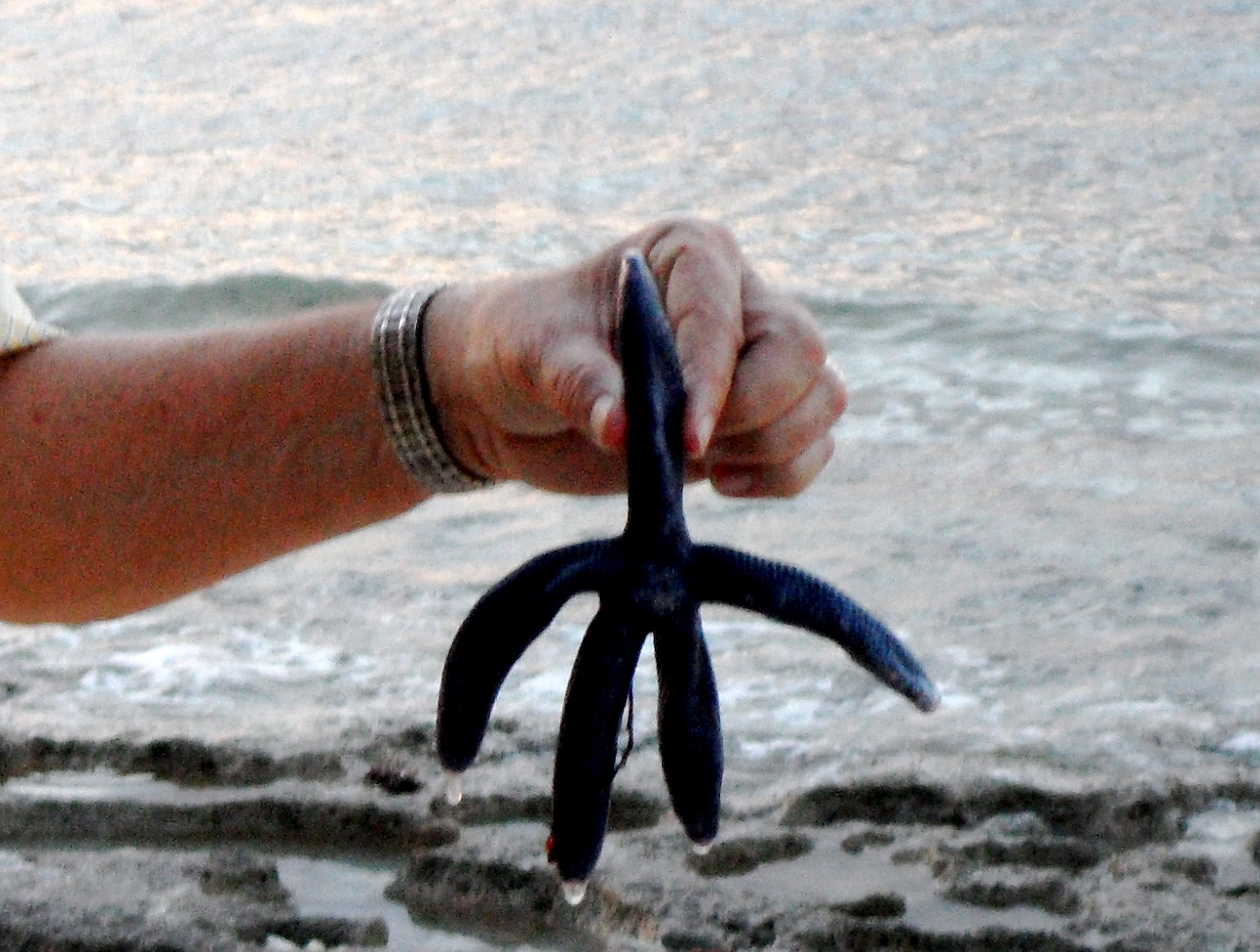
While with a group enjoying a coral beach exploration, I saw little fish and tiny crabs with bright green undersides in the tide pools, and one of the other senior missionaries found a blue sea star.  He brought it back for all of us to see, then flung it back beyond the reef, where it would have a better chance of survival than in a tidal pool when the tide was going out. 


The whitish liquid from the ends of this sea star’s arms was probably caused by the stress of being out of the water.

Then there was a truly special moment, when another couple showed us a hermit crab inside a shell.  They had been unable to pull the crab out of the shell, but they wanted to take the shell with them.  Call in the specialist – one senior missionary took the shell, and started whistling – a high, warbling, bird-like whistle – and what do you do know, the crab was coaxed out!  Another first for me!

And while not wild, something in plentiful supply – dogs.  We have been warned that most of the dogs here on the island are not friendly, and I will say that the night is filled with barking and baying.  But so far, the dogs I’ve met have been civil, and one particular dog was an excellent host.  He came and spent the evening with us on the beach near his owner’s hotel, even after we put the food away, and seemed especially fond of Jim, who sat down on the sand and gave him a good rubbing for about an hour.  We miss our own dogs, but this was a great doggy fix.

There are cats around, some domesticated and some feral.  But even the ones who live with families are pretty skittish, and it takes some real effort, and usually a few days of offering food scraps, to get a cat to trust you here.  And unless you want the cat to live on your back porch, you don’t do the food scrap thing. 

This is a young kiu bird - in English it's called a wandering tattler. Sounds like some children I know!  This has to be a cousin of a sandpiper – the long legs and the long beak just announce that this guy should be chasing sand clams along the beach, instead of looking for bugs in the grass (or standing in the shade of a flagpole on a sunny afternoon – he even looks like his feet are hot, doesn’t he?) I don’t know if they make any sound – I haven’t seen any of them singing yet. 

And this bird is called a red-vented bulbul, but I like the Tongan name better - a manufo'ou.  As soon as I saw this one, I thought, hey, there’s a cousin of a cardinal.  It has the same peaked cap, but is larger than a cardinal – about the size of an eastern mockingbird.  And it even has a flash of red and a splash of white, on the bottom and top of the back end of its body, just where the tail feathers begin.  These guys chirp and whistle all day long, and most of the night, too, when their mates are sitting on eggs.  And their chirp is similar to an eastern cardinal – Ch-ch-ch-ch-cheeerrruuppp!  No staying unhappy when you listen to them sing.  These are the birds we see most often. 

And my progressive friends will all be glad to know that every chicken on this island is free-range.  I missed getting a picture of the hen and her eight chicks crossing the road in front of our car the other day, but at least I got this handsome rooster at the roadside vegetable stand.  They don’t “cock-a-doodle doo” like the roosters I’m used to – they have a very wide, wobbly vibrato that makes them sound like sirens, especially at 4:00 in the morning! 

I for one am glad that there is such a variety of creatures on this planet.  Sure makes life more interesting and enjoyable – reasons to smile all day long.  And who doesn’t want a reason to smile?

Tuesday, November 15, 2011

If Music Be the Food of Love... Then Shakespeare Was in Tonga!

With the reversal of seasons in the southern hemisphere, summer is coming on.  The past couple of weeks have been graduation ceremonies for the local middle and high schools.  And of course, with my musical background, the best part has been the music.  There have been a lot of awards given out, and a lot of good speeches, but the emotional communication of music is what has resounded in my heart.

I have listened to about 15 different songs and performances in the past week or two, not counting church meetings.  And I am struck by the same comment that the first LDS missionaries made when listening to the Tongans: “Their voices are loud and clear, such harmony I have never heard.  God is in it all.”  The singing that is such an engrained part of the culture here is truly a little piece of heaven.  Boys and girls, men and women, old and young – everyone sings, their voices strong and sure.  And most of them are very good at creating their own harmonies – not necessarily those written in the music, but still wonderful, and sometimes even better than what’s on the printed page.  I wish I had a way to share with you the sounds of these people.  I’ll just have to refer you to a youtube film, with sound.  This clip is one of the UNESCO cultural projects for preserving native cultures.  You don’t have to watch all of it, but you’ll hear the kinds of harmonies I’ve been hearing: http://youtu.be/tF7KpvBl0tk


As with all cultures, a musical performance has its own protocols.  But I think the one most new to me is the fact that a singer (and other performers as well) can be properly congratulated during the performance.  Look at the picture of this teacher singing at a middle school graduation.  She is wearing a traditional Polynesian-style lei of flowers, but she is also wearing a lei of plastic-wrapped treats.  Those were given her during her song.  One of her students came up and placed them around her neck and she simply continued singing.  During the rest of the song,  about seven more of her students came up and either placed a lei ( of one kind or another) around her neck, or tucked money under her collar (look carefully just inside the lei).  Not a lot of money – usually one pa’anga bill, worth about 65 cents US.  But these gifts are a sign of affection and respect for her, and for her performance.  I congratulated her later for being able to concentrate on the song while she sang – I know I would have been extremely distracted by all the accolades while I was trying to sing a song!

Apparently that kind of congratulation is only offered if one is singing traditional Tongan music.  This young man, finishing 8th grade this year, sang the western popular song “You Lift Me Up” at his graduation (did a bang-up performance, by the way – accompanied by his mother), and everyone listened attentively, but made no move to cover him in flowers and treats.  Instead, they stood up and clapped their hands and whistled and hooted their congratulations.  Pretty standard western middle school behavior! 

Because these schools are church-run, (there are a few government-run middle and high schools on Tonga, but most of the secondary students attend schools run by the Mormons, Catholics and Wesleyan Methodists), each graduation ceremony began and ended with a congregational song and a prayer.  To hear a thousand voices joining in song is marvelous anywhere in the world, but to hear these untrained, instinctive musicians open their mouths and their hearts to music is awe-inspiring.  Because they are untrained, those who lead the singing must lead with their voices as well as their hands, and the audience responds more to a voice than to conducting.  And the harmonies, both established and invented, are sure to haunt me for years to come. 


There have been amusing musical moments, too.  I listened as this music teacher played pop music and traditional Tongan music during a dinner at an awards banquet, and smiled to myself as he sang “Jingle Bells” when it was about 84 degrees Fahrenheit outside.  With no Halloween or Thanksgiving to get in the way, it’s already the Christmas season here – there is a twenty-foot artificial tree already decorated across from our vegetable market, and icicle lights for sale at the open-air market. 


The other musical moment that made me smile came from a wonderful mixing of cultures.  Jim and I were invited to the “Welcome Home” party of a young sister missionary we met in the Auckland, New Zealand airport (she had served in the Phoenix, Arizona mission for 18 months).  We sat and listened to the loud, happy music played and watched everyone, from age 2 to 82, get up and dance.  (We chose to watch – my ankle’s not quite up to dancing yet, but I’m out of the boot and into an aircast, and even using just an Ace bandage for a few hours a day).  And then came “La Bamba.”  Even though it is sung in Spanish, it is very familiar to non-hispanics of my generation, because of its breakthrough popularity.  Well, it’s popular here in Tonga, too.  But the difference is that the Tongan version is performed by a Tongan singer, not Ritchie Valens.   The refrain is in Spanish, and very true to the original, but the verses are in Tongan, and have a completely unique rhythm and pace, which threw me for a few minutes.  But then I just accepted it and watched as the crowd enjoyed their version of an energetic song.  Smiled through the whole song.  And a little four-year old girl mixed traditional Tongan dance moves with pop dance moves - another reason to smile.


But the emotional high of the week was a performance by the entire Liahona Middle School, at the end of their graduation and awards ceremony.  The principal had composed the words and the tune, and had choreographed movements for the children to perform while seated on the floor, in a chair, or standing behind a chair, in what's called a "ma'ulu'ulu." So imagine three hundred children arranged in a huge horseshoe in a school gym, all in traditional Tongan costume, performing a 10-minute long storysong with complex head, arm, hand, and upper body movements, all in unison.  Oh, and some of the faculty and a few students played traditional drums over to the side – there were about 8 drums, the smallest of them desk-high and at least 4 feet across.  The performance was given twice, once so that everyone could simply watch, and the second time parents and family members came forward and showered their children with more leis and treats.   And their principal was also their punake - reviving their Tongan spirit through song, poetry and dance.  Wow.

Music has played a large key role in my life. To find myself now surrounded by natural musicians is an education like no other.  I just hope I can take it all in.

Monday, October 31, 2011

PARACHUTES


There is a story of a Navy pilot who, after having his jet downed and spending 6 years in a North Vietnamese prison, met a former sailor.  The sailor smiled and told the pilot “I knew you’d be okay.  You wouldn’t be here today without me.”  Confused, the pilot said, “I’m sorry.  I don’t even know you.”    The sailor replied calmly, “That’s okay.  I knew you’d be okay because I’m the one who packed your parachute.”

I have heard the phrase “pack your own parachute” used in many different analogies.  But this story puts a different perspective on that phrase.  How many of us have had our parachutes packed by someone else – perhaps even someone we don’t know? 

In the military, parachute shrouds (ropes) must be arranged in a particular order, skillfully folded below, between, and above the silk of the chute itself, in order to open properly, and provide life-saving protection to the person wearing the parachute.  Someone with expert training and a commitment to the responsibility of doing a job exactly prepares and packs the chute for whomever another who will use it.  And in most cases, those two people don’t even know each other.

So in my own life, I wonder – who has packed my parachute?  Some I readily acknowledge: parents, family members, teachers, leaders, friends, and students.  I know I have thanked some of them; I hope all of them recognize the good influence they have been on my life.  And if there are any out there who have not yet recognized that, then thank you.  Thank you for the kindnesses you have shown me.  Thank you for the time you invested in getting to know me, in supporting me in my efforts.  Thank you for the patience you have exhibited in trying to understand me.  Thank you for the love you have extended to me through your words, and through your service to me.  You have truly arranged the shrouds and silks of my life in such order that I have been able to stay safe, physically, intellectually, emotionally, and spiritually.

But as I reflect, I recognize that there are many people I have encountered only fleetingly who have packed my chute as well.  I remember being on the streets of Pusan, South Korea, and watching in amazement as a young man with no legs powered himself along the sidewalk on a homemade dolly, using his leather-wrapped hands.  When I am asked for examples of persistence, his image is one of the first that comes to mind, and I am grateful for his part in packing my chute.

And more than humans have packed my chute, it seems.  There is something about the smell of wet concrete in the summer that transports me back to my childhood in Arlington, Virginia, and brings a peace that transcends memory.  The perfect combination of cloud and sunlight that creates a rainbow, the calm that follows a summer cloudburst, the sound of water trickling down the downspouts, the songs of birds as they celebrate the end of a storm, the taste of the air – the emotional markers tied to these memories are strong, perhaps stronger with each repeated sojourn.  I find myself filled with gratitude and wonder as I ponder the way this wonderful planet has packed my chute.

And how have I packed the chutes of those around me?  Not the ones I have intentionally packed, those of my children, my students, my colleagues and friends, but those whose chutes I may have packed unknowingly -  the man playing guitar at the corner with the sign, asking for money to feed his children,  the housekeeper in the motel where I recently stayed, or the cashier at the store – how careful have I been with their chutes?  What can I do to take more care in arranging their shrouds and silks?  My resolve to be more careful in all my interactions becomes more vital and more critical to my personal success when I consider that my every action becomes a part of someone else’s life.  The alternative is frightening to contemplate. 

How fragile we all are, and yet how strong!  I know that there are people in my life who had negative effects on me, and yet either their impact on my life has been washed away, or it has become an opportunity for change.  It seems as though I have chosen those who have packed my parachute.  I can only hope that the same can be said for those over whom I exercised a negative influence.  I cannot change my past, but I can choose my responses to my present circumstances, and I can create within myself a character worthy of those who have invested their responsibilities and efforts in packing my chute.  And I can work to serve those around me so that my time in packing their chutes will be well spent.

We are, after all, traversing a sky that is not just minutes long, or even years.  Our parachutes must equip us for the eternities.