Tuesday, April 10, 2012

THINGS THAT MAKE ME SMILE


There are lot of things I love about this place. Just like any new place, there are things that are a little frustrating,  but there are a lot of things that warm my heart, make me laugh, or make me scratch my head.  But all of them make me enjoy my time here, and make me grateful to know I am not the only one still learning.

First rule in Tonga:  practicality wins out over style.  I have not gotten a proper picture, but I have seen this three or four times – a pickup truck with four or five young men riding in the back, in the hot sun.  Most of the time they just throw a tee-shirt over their heads as they ride, but I love it when I see someone with a piece of Styrofoam or cardboard, with a hole punched in the center, that he’s using as a sun visor!  Whatever works!

Now, sometimes the practicality backfires.  The other day, we were behind a van driving along the road with the tailgate partly open (as happens quite often here – at least you get a breeze through the van if the tailgate is open).  But he hit a pothole, and out bounced his chainsaw.  Oops!  Jim laid on the horn immediately, and the driver looked in his mirror and saw the problem.  I hope he shut the tailgate for the rest of the drive that morning. 

Second rule: I’ll give anything a try.  I watched a little girl (maybe 8 years old) trying to rollerblade the other day.  She pulled herself along the railings around campus – wearing inline skates that probably would have fit her father!  I had visions of myself at about age 4 when I used to stomp around the house in my dad’s workboots – but those never had wheels attached! 

Another illustration of this rule was at the church dance, celebrating the 170th anniversary of the Mormon Relief Society, the oldest continuously-operating women’s organization in the world.  There was a man of about 60 there, and his dance partners could not wear him out. He’d dance to any tune: Pacific pop, big band, rock, you name it – and he moved exactly the same way to every kind of music.  Go for it, brother – don’t worry about which dance fits what kind of music, just move the way you want!

Third rule: What’s yours is mine.  Jim made an avocado pie and had given the last piece to Fehi (FEH-hee), a friend visiting us in our office, when another friend, Mary, came in.  Mary saw the pie, and I told Fehi to give her a bite.  He offered her a bite, but she took the whole pie pan! Fehi did not let go, but Mary took off holding the pan, with Fehi’s arm still attached, and proceeded to eat most of the rest of the pie!  Fehi made only a small protest, but he still got some more of the pie along the way.  I laughed until I cried – it was like watching a couple of four-year olds! 

Another example was told to me by Maopa, a friend who should have been my sister.  She walked into the school office building with a piece of warm breadfruit (think of a basketball-sized potato that grows on trees), and her cousin, who is one of the administrators, literally took the breadfruit out of her hands, asked someone else to go get a can of corned beef from the little shop across the street, and that the meeting could begin because now they had lunch!  If that had been me, I’d have been shouting, “Wait a minute – that was MY lunch!”  But everyone here just smiles and shares.

Fourth rule: Don’t fix it if it’s working.   Liahona campus has its own sets of generators, because the electricity in Tonga is pretty unreliable.  So instead of being out of power for hours twice a week, we have backup generators that take over within 90 seconds.  Usually.  Last Saturday, the power went out, and the backup generator on our side of campus didn’t kick in.  So we found out finally what happened.  The generator was out of diesel.  The guy who was supposed to refill the tank had not done it because “Well, the electricity was working!”  Fortunately, the power came back on after about an hour, and we got two truckloads of diesel the following Monday. 

Fifth rule: Look pitiful and a Palangi missionary will feel sorry for you.  Five of us took a picnic lunch to the beach a few Saturdays ago, and a little boy about 9 showed up, hanging onto a tree, just as we started lunch.  We had some extra apples, so I tossed him one.  I don’t think he had ever seen one before, but after sniffing it and feeling it for a few minutes, he bit into it, and ended up eating the whole thing.  Then he went back to looking sad.  I gave him a few oatmeal cookies.  Those didn’t last long!  We didn’t have extra tuna salad, but we had a couple of extra rolls, so I tossed him the last two in a bag.  He sniffed the bag about twenty times, but when we didn’t offer anything else, he ate those, too.  And about halfway through putting away lunch, I noticed he had given up and left.  Well, he got lunch that day, anyway – I know that some people on that end of the island are lucky to get one meal a day – even our missionaries only eat once a day there, where they eat twice a day on the rest of the island.  But that little boy would have gotten food a lot faster by acting happy with me – might even have gotten more!

It’s not just food, either.  For a while, our office had books to loan out to children, but most of the kids thought they were gifts, so the books are now gone.  Hopefully the children are reading them.  The other day a couple of little girls came in, looked around in surprise to see the books were gone and when they said “Books?”  I simply said, “No more!”  They hung their heads in disappointment, then brightened and asked, “Stickers?”  I laughed – I had given out stickers to those who actually returned the books.  I gave them each a few stickers, and sent them on their way.  Not two minutes later they were back, looking pitiful again.  “Stickers?” they asked.  A teacher translated – they said they had lost their stickers, but more than likely they had given them to friends.  I gave them the rest of my stickers.  Now the stickers are “finished” as well. 

Sixth rule: Don’t hurt a Palangi’s feelings.  Another senior couple got in a car accident a few months ago, and found out that it was their fault.  The one-way street they were crossing had the right of way, and they didn’t know that.  So okay, pay the fine and you’re done, right?  No, the police wanted to have a meeting.  So they went to the meeting.  They spent two hours together with the police (not the other driver) and the police kept telling them that Tonga is called the Friendly Islands, so it was okay to talk about this accident.  If they felt they were in the right, they should write a letter to Parliament and get the laws changed.  How did they feel about the accident?  How did they feel about the law?  How did they feel about the other driver?  Well, that was all last December, but this past week the police came to Liahona to talk with them again.  Where are they? asked the police.  Well, I hope we didn’t hurt the policeman’s feelings when we told him that the senior couple in question had completed their assignment, so they had left Tonga and returned to the US! 

Seventh rule:   Move slowly.  I’ve been amazed at how all life – human or not – moves slowly here.  Drivers, pedestrians, even the few on bicycles – we are definitely on island time (except that Church starts on time no matter what, and announcements begin at ten before the hour, so if you want to know what’s happening, you’d better get there on time!).  Dogs never move faster than at a trot, although if you frighten a cat, it will run a short distance.  Birds, bats, even the wasps here move slowly, as if they’re dancing, not just flying.  I know, intellectually, that in this climate (we’re usually in the high 80s with humidity over 90%), you move slowly so you can last the day, but I also understand why no one loses weight – unless you exercise before 6 a.m. or after 10 p.m., you don’t last long!  But in Tonga, everyone is beautiful, no matter their shape, speed, height or skin tone – I love it here.  It’s Tonga.  And it makes me smile.

Monday, April 2, 2012

THE DEATH OF A KING

We have been participants in history.
Yes, everyone can say that on a daily basis, but it’s not often we realize it while it's happening.  This week, a Tongan king was laid to rest, and we were privileged to be both witnesses and participants in the rituals surrounding his being laid to rest.
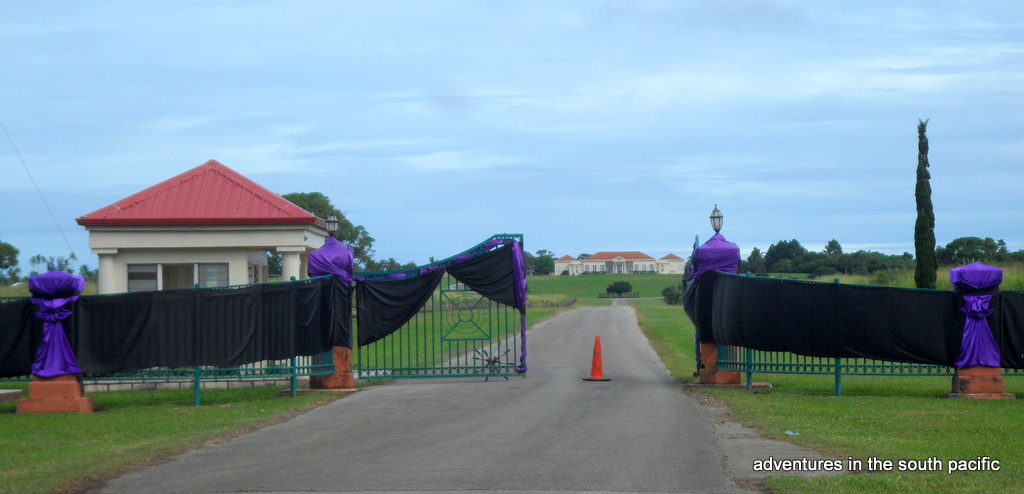
The King's villa, draped in black for mourning, and purple for nobility or royalty.  
King George Tupou V, age 63, had a kidney transplant a year ago, and never really recovered.  He still appeared at ceremonies and important political events, but he no longer toured his island in his converted London taxi, or entertained guests with Agatha Christie-style murder mystery parties.  He passed away in a hospital in Hong Kong, and last Monday, March 26th, his body was returned to Tonga in a Chinese jet.  Mourners from his family and the noble class of Tonga greeted his body in a ceremony at the airport, then his casket began the 10-mile-per-hour long ride to the royal palace. 
A little one walks down the road with a fan in her hand.  You can see the villagers who have laid tapa on the road in the background.  They are sitting on it simply to keep the wind from blowing it out of place.  
In his short five-year reign, this king had endeared himself to his subjects through his common touch.  In the videos I have seen of him (and there have been many over the last couple of weeks), I notice that he never seemed quite comfortable with the idea of being singular.  When he would stand in front of a crowd, his eyes would dart back and forth as though he was looking for someone else who deserved the attention more.  His expression varied from slight discomfort to evident embarrassment, which is a direct expression of the Tongan culture; no one here wants to be singled out in front of others as a commendable example.  All of the Tongans I have spoken with have reported that he had an air of accessibility, that for all his eccentricities (he enjoyed riding a motorcycle, and was known to wear a pith helmet), he communicated a concern for every citizen. 


Well, Jim has been asked if he's Tongan, but I'm just Sister Tomato, turning
red every time I sit out in the sun (forgot the sunscreen!).
All along the road from the airport to the palace, Tongans (and a few of us non-Tongans) waited to pay respect to their fallen king.  We didn’t know exactly what time the Chinese jet would land, but the entire student body of Liahona High School and Liahona Middle School (1300 students), plus faculty, staff and administrators, waited out on the road for his body to pass.  Every other school in Tonga had their students gathered on the road as well – children from age 6 to 19 were all in their school uniforms, while adults wore the traditional black clothing with a straw mat and dried-grass skirt.  Most of us were on the roadways by 11, and the police, in their white dress uniforms, were diverting traffic by 12.


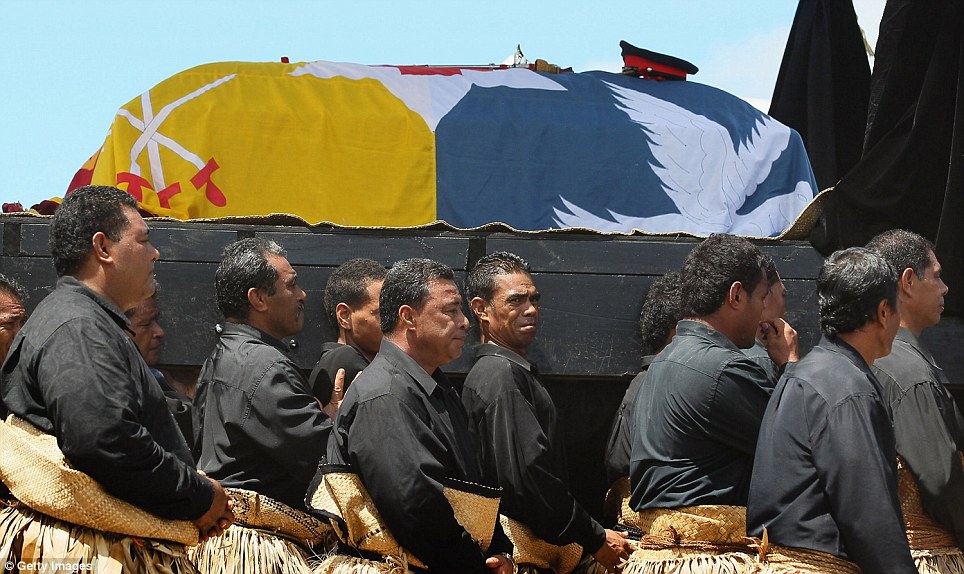
It was a quiet social time, until about 3:00, when we finally had a police car go by with headlights and roof lights flashing.  That was our signal to go sit down on the edge of the road and be silent.  After a few more minutes of waiting, we saw the big elevated-flatbed truck coming down the road, with a ceremonial canopy that probably was 30 feet in the air. The royal flag was draped over the coffin, and as it passed by, every head bowed low in respect.  As far as the eye could see, the road was lined with silent people, as the truck, then a procession of cars with dignitaries and Tongan nobles passed by.  A few of us Palangi (non-Tongans) lifted our heads long enough to get pictures, but I didn’t see a single Tongan head lift until every car had passed. 

Then the sociability returned – people smiled, laughed, and helped each other into cars and buses to return home.  We were still dressed as mourners, but we were determined to be happy, for that is what King George Tupou V would have wanted.

This is St. Andrew's Church, with the most beautiful bunting in the nation right now.

On Monday night, tiny vigil fires were built all around the palace fencing, and students from many schools tended the fires all night long, while church groups from all over Tonga participated in prayer services on the palace green. The LDS Church was well represented, with more than 200 people seated under a tent to sing hymns and offer testimony and prayer during their assigned hour. 
The funeral casket, bier and canopy begin their journey from the palace to the royal tombs.   


The funeral was held Tuesday.  150 pallbearers carried the king’s coffin on a huge bier – a frame that was at least 50 feet long and 20 feet across.  There were extras who walked right next to the pallbearers, so that when one was exhausted by the weight, someone was ready to take his place.  


They followed elite military units -  Army, then Navy, then the royal military band – in a hesitation-step march from the Palace to the royal burial ground and tombs – about a 30-minute procession.  As on Monday, special handpainted cloth made from pounded bark called “tapa” (TAH-pah) served as carpeting for the military and pallbearers to walk upon for much of the procession.  Each large tapa you see in some of the pictures I’m posting today represent about 2000 hours of work.


The Free Wesleyan Church of Tonga conducted the funeral, but there were representatives from all churches present, along with international dignitaries (the crown Prince of Japan and his wife both attended, along with the Prime Minister of New Zealand and too many others to list). 
Then Wednesday was a day to breathe.  School was in session, but I imagine not a lot was accomplished.  Too many students were thinking about what their offerings would be on Thursday.  I know my teachers were not in learning mode for their class after school - only half of them even attended.  


The bush is a plant called kava, part of a ceremonial drink,
and the big long root vegetables are called ufi (ooo-feee).
And yes, those are live pigs in the cages.
Thursday:  Ha’amo Day. This was the day that the poorest of the poor bring their best gifts to the royals, as evidence of their grief.  So about 700 pigs ready for slaughter (the big ones, not the little piglets that families often barbecue), miles upon miles of tapa, root vegetables and bananas by the bearing-basketful, and any kind of treat families can come up with – leis of candy, cookies, cakes – all donated by people whose average income is probably about $100 a month.  The new king seems set to change this tradition, but he may not be able to do it in time for this round of ha’amo (hah-AH-moh).  As comfort to the Queen Mother, every family with students at Liahona was asked to prepare a cake or sweetbread for her.  That’s about 650 cakes.  What? We’re going to run out of flour!  This is an island, remember?  Panic is setting in on my little Palangi brain…


These baskets are about three feet long each, and are carried
 in by two people. And you can see the cakes!


Ah, we'll manage, say my Tongan friends.  It won't be the first time we've done without.  She's the Queen Mother, and she has lost her son.  We'll show her our sympathy and devotion to her with our gifts, and then later we'll figure out how to cook for our own families.  These humble, faith-filled people are used to sacrifice.  Looks like it's my turn to be taught.  

Saturday, March 24, 2012

UP TO MY EYEBALLS


Well, I haven’t posted lately because I’ve been up to my eyeballs in work!  We spent most of the last month  helping young adults finish their applications to BYU-Hawaii – I know we helped complete at least 50 applications.  To 
be scanned and faxed:  high school transcripts, family financial papers, recommendations from LDS Bishops and Stake Presidents (local and regional leaders), letters of sponsorship from U.S. relatives,  certification of English proficiency (from a test we administer monthly), and applications for BYU’s version of work-study, called IWORK.  Ends up being about 12 papers per student.  Add to that about 4 hours of typing in a second language -  I’m glad I’m not applying to college these days, because I  don’t have the patience for it!  Whew!


BUT, the surge is finished, and since BYU has no available IWORK for this fall, most of our qualified applicants are going to be online students to start off.  The school here may open one of its computer labs in the evenings, so young adults can use it to “attend” their online classes.  I can’t wait until that happens, because already we have three and four people waiting on the two available computers in our office.  I have to run someone out of the classroom where I teach in order to hold my own classes from four to six in the evening! 

The entrance to Liahona High School.  


Jim is enjoying the chance to observe teachers, as they do the version of student teaching we do here.  Even though most teachers here have four-year degrees, almost none of them have degrees in education, so in come the Szokas  (latest in a very long line of senior missionaries) to act as adjunct professors for BYU-Hawaii, to teach these college-level courses in education.  But since these teachers are already in the classroom, we tend to approach them as graduate-level workshop classes, rather than “read the chapter and answer the questions” undergraduate classes.  Makes the courses a lot more pragmatic when you can go back to your own classroom and try something out.
Anyway, Jim has been thoroughly delighted with two particular teachers he has observed.  Kalo (Kah-low), a math genius, is in her third year of teaching, and she is remarkable already.  Not perfect, but every time Jim gives her a suggestion, she puts it into practice, and he sees it the next several times he comes into the classroom.  She has a better understanding of teaching, both in theory and practice, after two and a quarter years, than I did after 12 years! 

The other teacher, Makaleta (Mah-kah-lay-tah, the Tongan version of Margaret), is simply incredible.  She has been a lab assistant for the past four years, and is serving as a long-term substitute this year.  But she has applied everything she has learned in the classes she has taken here, and both Jim and I feel we could recommend her to any school system in the world.  She teaches 9th grade science, and here’s an example of her teaching:


In any second-language situation, you want to use a lot of visual aids.  Makaleta was teaching the concept of peristalsis, in which the muscles of the esophagus contract downward in a pattern that moves the food down to the stomach.  So what was her visual aid?  Not a simple picture, not something high tech – she put an apple inside a nylon sock, and pushed it down little by little from behind the sock, while her students watched the apple “magically” get pushed down.  Great demonstration!  Even if her students had a hard time pronouncing the word, they certainly understood what it meant!

Sometimes I feel like I'm  trying to
get a cow to fly, when the cow wasn't
designed to fly...knowhatImean?
Me, I’m having a roller-coaster ride helping classes of teachers figure out how to teach.  I go from being impressed that a Seminary (LDS religion class) teacher decides to try out reader’s theater to help her 9th grade English language learners get past the archaic English used in the Old Testament, or being amazed at the grasp of “hands on” activities a new automotive teacher has, even to the point of having students create an active scenario about treating a victim of electric shock (rather than just talking about the safety rules) to being totally tickled and not a little wide-eyed when a new teacher writes in his “reflecting on our practice” journal that he never considered sharing his vocabulary words with his students.  That makes me wonder what he thought vocabulary words are for – are they classified information or something?  Hee hee.

Seriously, though, most of the teachers are making earnest efforts to apply what they learn in these classes, and you have to be impressed that someone with a business degree who decides to come back to Tonga to teach, spends a couple of years taking classes after putting in a full day of teaching, in order to satisfy the requirements the LDS Church has placed upon them.  That’s dedication.  Now if I can just get them to recognize that we have to teach BEYOND the year-end exams.  We need to teach skills which these teens will use for the rest of their lives, skills like time and resource management, decision-making, problem-solving, flexibility and self-direction – these are skills very absent in the traditional Tongan culture, but the curriculum here at Liahona Middle School and Liahona High School can be an effective vehicle for learning those skills.  Hey, wish me luck – I dream big!

Monday, February 27, 2012

BACK TO BUSINESS


Two cyclones in two weeks.  Whew.  First Cyclone Cyril brushed past us, flooding the eastern end of our fishhook-shaped island, and bringing the mango season to an early end – there were thousands of mangoes for sale for a few days after Cyril, and then - done.  Then seven days later, Tropical Cyclone Jasmine began toying with Tonga.  Her track went northeast from Australia, then she did a Dr. Seuss-worthy loop in place just west of us that lasted four days, before she finally headed southeast and dissolved over the empty ocean.  During those four days, we went from sunshine to sprinkles to 28 inches of rain in 24 hours, and back to sunshine, with the humidity staying at nearly 100% the whole time.  Can you say soggy?

The Humanitarian Services building downtown -  this was
typical of the flood damage.
Jasmine did much more damage to our island than Cyril.  The houses which were flooded the first time didn’t even have time to dry out before they were inundated a second time.  And even in our area, the center of the island, the storm brought down trees and damaged buildings – that lovely little roadside stand that I showed in the last blog was completely in shambles, though I must say the industrious family had a makeshift version up about five days after the storm.  I expected some of the softer-wood trees, like pines and coconut palms, to suffer, especially the ones with small root systems, but I have been surprised at the number of large, hardwood trees split open by this Category One storm.  Makes me wonder what would happen in a Category Four – no, never mind, I don’t have to find that out.

Well, living on an island during a storm has taught me the value of the phrase “batten down the hatches”.  Most of the stores downtown boarded up their glass windows and rolled down their metal security doors, to be secure.  I expected that kind of preparation, but there were a few surprises in store for me.  The electricity went out (nothing new, that happens frequently here, but Liahona Village has their own backup generator), and along with that, our internet connection.  We don’t have a key to get into the storage area to push the “reset” button on the internet supply, so we were without an internet connection for three days, until the Tech crew reported back to work.  Couldn’t get a weather report, couldn’t tell family what was going on.  Then the TV stations (there are only 2 here) stopped broadcasting.  Their equipment is not sturdy enough to be exposed to winds of hurricane speed, so they just closed their doors and sent everyone home.  And finally the cell phone service was cut – again, the antennae are subject to damage in high winds, so they retracted their antennae.  I felt like I was in a time warp, about 50 years in the past.  I can’t remember being as isolated as that since 1958, when a snowstorm made Falls Church, Virginia look like Nome, Alaska, and my mother boiled snow for drinking water.

Again, the eastern end of our island suffered the most – flooding, roofs torn off, electrical wires down, even along the road that leads to the King’s Palace.  And lots of downed trees.   The Red Cross brought in emergency clothing, bleach and soap, to help families stave off water-borne infections.  The Prime Minister made an official address to the nation, thanking families for protecting each other during and after the storm.  Thank heaven the village structure is still alive and well here, with the chiefs making sure that every family was okay, and reporting to the government.  No fatalities were reported, and that’s always a good thing.

Our little home was pretty safe during the storm.  We did get some water inside the “attic” space, and it managed to drain down into our bedroom ceiling light fixture, on the north side of our home, where the wind was blowing the rain sideways.  At the end of the second day, an electrician came to our house and drained the water from the light fixture.  He took the rest of the fixture apart, wiped it dry, and reported that even though the water that had collected in the light was orange with rust, apparently the water hadn’t gotten into the wiring.  The wiring looked safe, so he put everything back together and said it would be okay.  We still waited a couple extra days before we turned on that light, just to make sure everything DID dry out!  Keep your fingers crossed, no problems since. 

As the electrician left our home, Jim noticed that he was barefoot.  “Did you leave your shoes inside our house?”  asked Jim.  “Oh, no,” replied the electrician, “I left them at the last house I worked at.  The house was flooded, so I just left my shoes outside, and I forgot them there.  I’ll go back for them now.”  It wasn’t until later that Jim and I understood the impact of that electrician’s statement.  He had been working in a FLOODED room on ELECTRICAL WIRING – without wearing rubber shoes!  And if his example in our house was any indicator, he hadn’t ever turned the power off to the wires. 

Years ago, when we lived in Naples, Italy, we used to joke that you were completely comfortable in Naples when you offered to light the cigarette of the gas station attendant filling the tank of your car.  Now we’ve got one for Tonga – you’re completely comfortable when you invite a barefooted electrician to come work on live wires in a flooded room!  Ha!

Our other casualty was our little Macbook – apparently four days of 100% humidity was more than the six-year old laptop could handle.  We’ll buy another one and have it shipped from New Zealand, but it will take a few more weeks, doing bank transfers and waiting for delivery.   Nothing happens quickly in the islands!  Here’s  hoping the next one is more moisture resistant!

So, all the trees are a little one-sided now, but life is getting back to normal.  It took three weeks to have six days of school, and some of the schools closer to the coast still have large pools of water on the grounds, but everyone really appreciates the sunshine and the breezes, and we’re all grateful for the protection and shelter we enjoyed during the storm.   Thanks to our window-unit air conditioners, we have dried out.  And the sky seems a little bluer, the air a little cleaner, the birdsongs a little more joyous, the flowers a little more colorful.  Life is wonderful – now let’s get back to business.

Saturday, February 11, 2012

TO MARKET, TO MARKET...

 Shopping in Tonga is an adventure.  This is still a third-world country and small shops are the way of life, but the culture is strangely cooperative when it comes to retail – two shops next to each other will carry similar products, but different brands, so both can prosper.  But since there are mostly small shops, it takes a significant effort and at least two hours to do a simple grocery run.

We do our shopping on Wednesday mornings, while the other missionary couple covers the office for us.  Then they shop Friday mornings while we cover.  If we have to wait and do a Saturday run, we want to be out of the house early – by 10 am the crowds are tremendous.  Most people here in Tonga do their major shopping on Saturdays.  We were in a store a couple of weeks ago the Saturday before school began, and there were about 50 people waiting in line for two registers.  At least people are social here – you just stand and talk with just about anyone while you wait in line.  Hey, wait a minute – that’s exactly what used to happen to me in the Alamosa, Colorado Walmart!


Anyway.  First stop is the “maketi” (mah-keh-tee) – the “Tonganized” word for market.  This is where all fresh produce is sold, other than at family-owned roadside stands.  We are regular customers of a Chinese family here who raise bok choy, bib lettuce, English cucumbers, and eggplant.  The women who sell here always give us an extra piece of pumpkin or some mangoes, as a gift, to keep us coming back.  And we do


Other vendors have tomatoes, carrots, bananas, pineapples, green peppers and (when it’s not too hot) zucchini.  Things are not weighed here – you can get five or six green peppers for three pa’anga (pah-ahng-ah – that’s about $2) when they are plentiful, or you can pay six pa’anga for one small pineapple when the season is ending.  Eggs are cheap right now – about $6 for 30 of them.  That’s the Tongan version of a back-to-school special!  Usually they’re more like $10-14 for 30 small ones (the only size).


This old gentleman speaks no English, and I speak about 5 words
of Tongan, but we smile and greet each other every week.


And at every doorway to the maketi, the old men abound.  Most of the women are here to work, and most of the men are here to play.  They sit and smoke cigarettes, or they play cards or board games, or they just sit and talk.  Or they stand around outside wearing only one flip-flop – I still haven’t figured that one out.  In any case, they seem to find their entertainment here, and they are always glad when we say hello to them.


Compared to other shops, the market is huge – a two-story building the size of a grocery store.  There are probably 70-80 different vendors, some with only 6 feet of table space, others with 30 feet of display.  There are gutters built into the floor, so you have to be very careful when you walk around – it’s easy to step wrong, and I’ve had enough turned ankles for a while!  The upstairs is mostly fabric and hand-made jewelry, the first floor is produce, flower leis, and crafts.    Once again, the prices vary wildly, even from month to month.  I can get a pair of coconut-shell earrings for  $2, and a hand-made basket might be $8, but then a lei might be $30.  Just depends.  


This woman's son is serving a Mormon mission in Colorado Springs, Colorado.
Nice to trade places.  Those are handmade fans above her head.
This man may not look like he's working, but he's a traditional artist.  That's not a quilt beside him, that's a traditonal bark painting called a tapa.  I couldn't afford one of the big ones (they can reach half-a-block long and street wide), but I got a little 11X17 one.


So now we’re finished at the market.  Some weeks we make a stop at the U.S. Mini-Mart across the street.  Imagine a small 7-11, with only two aisles, supplied by the owner who flies back the States every three or four months, and makes the purchases himself at CostCo and other places, packs his own container, and has the contents shipped to Tonga, which takes 4-8 weeks.  Fortunately, he’s willing to take orders – some of us senior missionaries are going to split a case of cornmeal, and I’ve ordered a case of hair spray.  This is a culture of grow-your-hair-long and tie it back – I can do that, but I need some glue!  

Then it’s on to Molisi’s, (Moh-lee-sees), where we can get chicken, pasta, rice, flour, sugar, and so on.  Oh, and Granny Smith apples from New Zealand.  That’s a sack lunch staple (we usually eat lunch at the office).  This is also the place I can get composition books for about 75 cents each, and sticky notes are cheap too.  But paper plates are $20 for 25 plates – gotta watch what we buy. Oh yes, we could buy a crock pot there, too, if we wanted to pay $200 for one.  Never mind, we’ll slow roast in the oven at home.  (Scratch cooking is a must here – canned corned beef, ramen noodles and three or four choices of cold cereal are about all the choices for processed foods.)

Other shops include Lord’s – electronics, some clothing and fabrics, and eye shadow, if you want 24 color choices – everything comes in a palette here!  Then there’s the store the missionaries call Home Depot – we went there because we were told they sold curtain rods.  Turns out you buy dowels and brackets – and the day we were there they didn’t have dowels and brackets in the same size.  Oh well – our cafĂ© curtains will continue to hang from shoelaces wrapped around nails!  There’s another shop the missionaries call Towers, since it’s located on the ground floor of one of the few 4-story buildings on the island (and one more is right next door).  


Now if you are really into impulse shopping, you wait until Saturday and go to the open-air market, which for some reason is called the Fair.    Families with relatives in New Zealand, Australia and the U.S. receive shipments from their relatives – used clothing, shoes, durable groceries (peanut butter is a big seller, and so is Crest toothpaste) and toys, for family members to re-sell here.  There are also some produce vendors, but their prices are higher than in the maketi.  And there are some vendors selling skewered meats and veggies – smells great, but the meat still has bits of bone in it, whether it’s chicken, pork, or beef.  So you chew carefully.  I’d rather go to the far end of the parking lot and buy some freshly caught tuna and swordfish.  Yum.
Red and white are the colors of the Tongan flag, so the family
celebrates by decorating the roadside stand!


On the way home, we usually stop at this roadside stand, where a family sells the produce they grow on their farm “in the bush” – back in the central part of the island.  I love the way they wrap the front poles of their stand with palm leaves, and decorate their stand so nicely.  This family grows the best watermelons on the island.  


And right across the street from our home is “Pink’s” -  one of the stores the Tongans call  Chinese Stores, because there are a lot of Chinese who operate these stores. Ours is operated by a Tongan.  She sells convenience foods like candy and soda, but she also sells bread and rolls, milk, and even yeast – all at the same prices as the big stores half an hour away in town.  Imagine a shipping container  with one side cut open to form a window with heavy wire grating across it, and as much food packed onto the shelves as one person can reach, and you’ve got Pink’s.

So, to market to market, then home again, home again, jiggety jig.  Well, not exactly.  Elapsed time: three hours eleven minutes.  We can do a minor run in about an hour and a half, if we hurry.  But everything moves slowly on this island – even the wasps – so we’re learning it’s okay not to hurry.  Now all that’s left is to put away the food, rinse the produce in bleach water, and stick everything in the refrigerator to keep it away from the ever-present ants.  Like I said, everything here is an adventure!